AI Browser Agents in 2026: How SMEs Use AI Operators to Automate Back-Office Work
AI Browser Agents in 2026: How SMEs Use AI Operators to Automate Back-Office Work
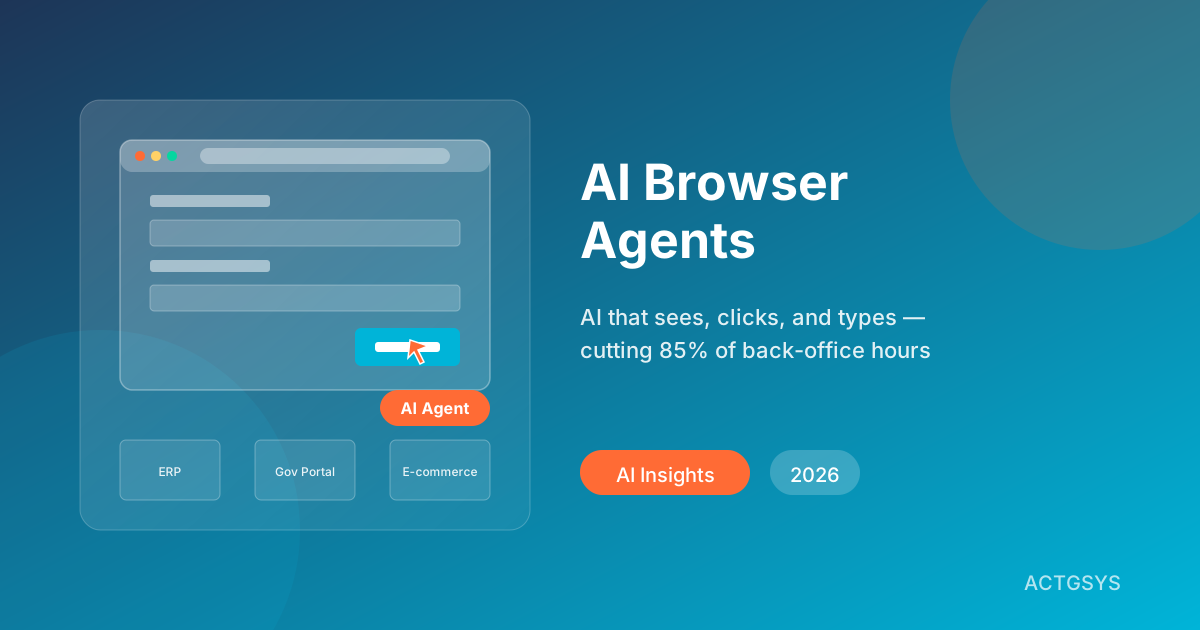
Short answer: An AI browser agent is an AI that sees the screen, moves the cursor, types, and completes web tasks autonomously. It replaces traditional RPA on ERPs, government portals, and supplier back-ends, saving SMEs 75–85% of repetitive back-office hours.
The biggest AI breakthrough of 2026 isn't "a smarter chatbot" — it's AI that operates your computer. Anthropic's Claude Computer Use, OpenAI's Operator, and Google's Project Mariner have moved AI out of chat windows and into your browser. For SMEs, this means the back-office automation that used to be reserved for enterprises — ERP data entry, tax portals, supplier order systems, e-commerce admin — is finally within reach. This guide covers the technology, five highest-ROI use cases, and a realistic deployment path.
What Is an AI Browser Agent?
An AI browser agent is an AI agent that autonomously operates a web browser to complete tasks. Its core capabilities: visually understanding screens, planning steps, simulating mouse and keyboard input, and recovering from errors. According to Andreessen Horowitz (2026), the AI browser agent market will hit US$12 billion in 2026, growing 200%+ year over year.
Representative technologies:
- Anthropic Claude Computer Use — launched October 2024, can screenshot, click, and type
- OpenAI Operator — commercial browser agent launched in 2025
- Google Project Mariner — Gemini-powered web agent
- Browser Use (open source) — framework SMEs can self-host
AI Browser Agent vs. Traditional RPA vs. API Integration
| Dimension | Traditional RPA (UiPath) | API Integration | AI Browser Agent |
|---|---|---|---|
| Works with | Pre-recorded flows | Only systems with APIs | Any web page |
| UI change tolerance | Breaks easily | N/A | Visually adapts |
| Dev cost per flow | US$1,500–6,500 | US$1,000–3,300 | US$600–2,600 |
| Maintenance burden | High (re-record on UI changes) | Low | Moderate (much lower than RPA) |
| Natural language instructions | No | No | Native |
| Handling unseen pages | Fails | N/A | Reasons and adapts |
Traditional RPA's fatal flaw is brittleness — move a button and the flow collapses. AI browser agents use visual understanding and handle UI drift an order of magnitude better.
Why 2026 Is the Inflection Year
Three technical breakthroughs matured simultaneously:
1. Vision models crossed the practical threshold. Starting late 2025, Claude Opus 4.7 and GPT-5 pushed screen-understanding accuracy from 70% to 92%+, reaching commercial viability. According to Anthropic's own published benchmarks (2026), Claude Computer Use achieves 44% task completion on OSWorld, up from 14% in 2024 — a 3× jump.
2. Cost dropped into SME range. Per-task cost fell from US$0.50–1.50 in 2024 to US$0.05–0.15 in 2026. An SME with a US$300/month budget can run 2,000–6,000 agent tasks.
3. Safety sandboxes and permission models matured. The biggest early concern was "an AI clicking random things on my computer." Mainstream 2026 platforms now ship isolated sandboxes, fine-grained permissions, and human-in-the-loop confirmation for critical actions — finally production-grade safe.
Five Highest-ROI Use Cases for SMEs
Based on ACTGSYS deployments over the past 8 months, these are the highest-ROI scenarios:
Use Case 1: Government and Tax System Automation
The most painful back-office work for Taiwan SMEs is government portals — Ministry of Finance e-invoice, labor insurance, MOEA Commerce, local tax bureaus. Most have no APIs. Traditional RPA requires custom scripts for each site with painful maintenance.
AI browser agents:
- Log into multiple government systems (with 2FA human confirmation)
- Batch-upload e-invoice files
- Download VAT reports and archive
- File labor insurance changes automatically
Real result: a 30-person trading company cut its finance lead's monthly government portal work from 24 hours to 3 hours.
Use Case 2: Supplier Portals and E-Commerce Batch Operations
SMEs often juggle 10+ supplier systems (quotes, orders, tracking) or e-commerce platforms (Shopee, momo, PChome admin panels).
AI browser agents can:
- Sync product info and stock across 10+ e-commerce platforms
- Batch-confirm delivery dates across supplier systems
- Auto-download shipping documents and invoices
- Periodically scrape competitor prices and report back
Real case: an e-commerce customer cut product update time from 6 hours to 25 minutes, with missed-update error rate falling from 12% to 0.5%.
Use Case 3: ERP Data Entry and Cross-System Sync
Dinkoko ERP ships full APIs, but many SMEs still run legacy on-prem ERPs without them. AI browser agents:
- Read order data from Excel email attachments and key it into ERP
- Sync closed-won opportunities from CRM to ERP
- Export ERP reports on schedule and upload to cloud finance tools
This is the cheapest bridge between old and new systems.
Use Case 4: Market Intelligence and Competitor Monitoring
SMEs can't afford full-stack market intelligence platforms. AI browser agents serve as a "digital researcher":
- Scrape 20–50 competitor websites daily for prices and launches
- Monitor industry news and policy changes
- Pull prospect signals from LinkedIn and Crunchbase
- Auto-generate weekly briefings for leadership
One B2B customer cut weekly intel-gathering from 8 hours to 30 minutes.
Use Case 5: Customer Support and Back-Office Finance
For high-volume customer operations (refunds, invoice corrections, account updates), AI browser agents:
- Process standardized customer refund requests
- Bulk-generate and send invoices
- Download statements from multiple payment platforms and reconcile
- Handle Tier-1 ticket actions automatically
A 6-Week SME Deployment Path
Week 1: Process audit and ROI ranking
- List every repetitive web-based back-office task
- Rank by (hours × monthly frequency × error cost)
- Pick the top 3–5 highest-ROI flows
Week 2: Tech and security architecture
- Choose cloud-hosted (OpenAI Operator, Anthropic API) vs. self-hosted (Browser Use + Claude Opus API)
- Decide sandbox level and permission boundaries
- Design human confirmation for critical actions
Weeks 3–4: First agent build and pilot
- Develop the top-ROI flow first
- Build error handling and human-fallback escalation
- Run 50–100 tasks and calibrate
Week 5: Monitoring and dashboards
- Track task success rate, runtime, error categories
- Set anomaly alerts (e.g., 5 consecutive failures notifies lead)
- Put a cost cap in place
Week 6: Scale to more flows
- Clone framework to flows #2 and #3
- Document operations SOP
- Establish periodic human spot-checks
Risks and Controls
Three risks to address before deployment:
Risk 1: Wrong real-world action. e.g., wrong order, wrong transfer. Control: require human confirmation for any action above an amount threshold, any email send, or any critical data modification.
Risk 2: Credential security and privilege creep. Agents need logins. Use dedicated accounts (not employees'), enable audit logs, and lock access to specific IPs.
Risk 3: Target system terms of service. Some platforms' ToS prohibit bots, especially scraping. Review ToS before deployment and negotiate API access where needed.
Expected KPIs After 90 Days
| Metric | Before | After 90 days | Change |
|---|---|---|---|
| Monthly back-office hours | 180 | 28 | -84% |
| Data entry error rate | 8.5% | 0.7% | -92% |
| Cross-system data latency | 4–8 hours | 15 min | -96% |
| Staff time on strategic work | 35% | 68% | +94% |
| Cost per task | US$2.80 | US$0.20 | -93% |
Frequently Asked Questions
Will AI browser agents fully replace RPA?
Medium-to-long term, yes; during the transition they coexist. RPA still wins on ultra-stable, high-frequency, low-variance flows (e.g., factory fixed-format reports). AI browser agents win on dynamic, varied, semantic scenarios. The 2026–2028 trend is AI browser agents gradually consuming the RPA market.
Can SMEs without engineers use AI browser agents?
Yes. In 2026, multiple vendors (including ACTGSYS) offer no-code AI browser agent platforms — users describe the task in natural language ("every morning, log into this site, download yesterday's report, and email it to me") and the agent is built automatically.
Will AI leak my passwords?
Not if configured correctly. Standard practice: (1) store credentials in an encrypted vault (1Password, Vault); (2) agents access via ephemeral tokens, never see plaintext; (3) run in isolated sandboxes; (4) full audit logs. ACTGSYS deployments include a complete security setup.
How much does a single browser agent task cost?
By complexity: simple (login, download, upload) US$0.07–0.17; medium (form filling, multi-step) US$0.17–0.50; complex (reasoning, error recovery, multi-site) US$0.50–1.70. A monthly US$350 budget buys 500–2,000 tasks — roughly one part-time employee's output.
If a website redesigns, does the agent break?
Compared with RPA, AI browser agents use visual understanding and typically auto-adapt to small redesigns (button moves, color changes). Major redesigns (full flow rework) still need adjustment, but at 10–30% of RPA's maintenance cost.
Which industries benefit most?
Highest-value industries: (1) import/export (multi-country government portals), (2) e-commerce (multi-platform admin), (3) financial services (cross-platform reconciliation), (4) manufacturing (supplier system integration), (5) logistics (shipment status consolidation). Essentially any business operating across multiple web systems benefits.
Closing: The Last Mile of SME Automation
For the last decade, SME automation progressed only where APIs existed. The 60% of work that requires "logging into a website and clicking through things" has been an automation black hole. AI browser agents close that last mile. SMEs that deploy in 2026 will accumulate a 30–50% operational efficiency advantage over competitors in the next 2–3 years — a gap that, once open, is hard to close.
Ready to cut back-office work by 80%? Contact ACTGSYS for a free AI browser agent process diagnostic, backed by our 90-day ROI guarantee. Learn how we integrate AI browser agents with Dinkoko ERP and DanLee CRM.
Last updated: 2026-04-18
Products & Solutions in This Article
AI-powered CRM for lead management, customer tracking, and sales pipeline optimization designed for SMEs.
AI-driven ERP focusing on procurement, inventory, and supply chain management. Each customer deployed on dedicated cloud infrastructure.
Related Articles
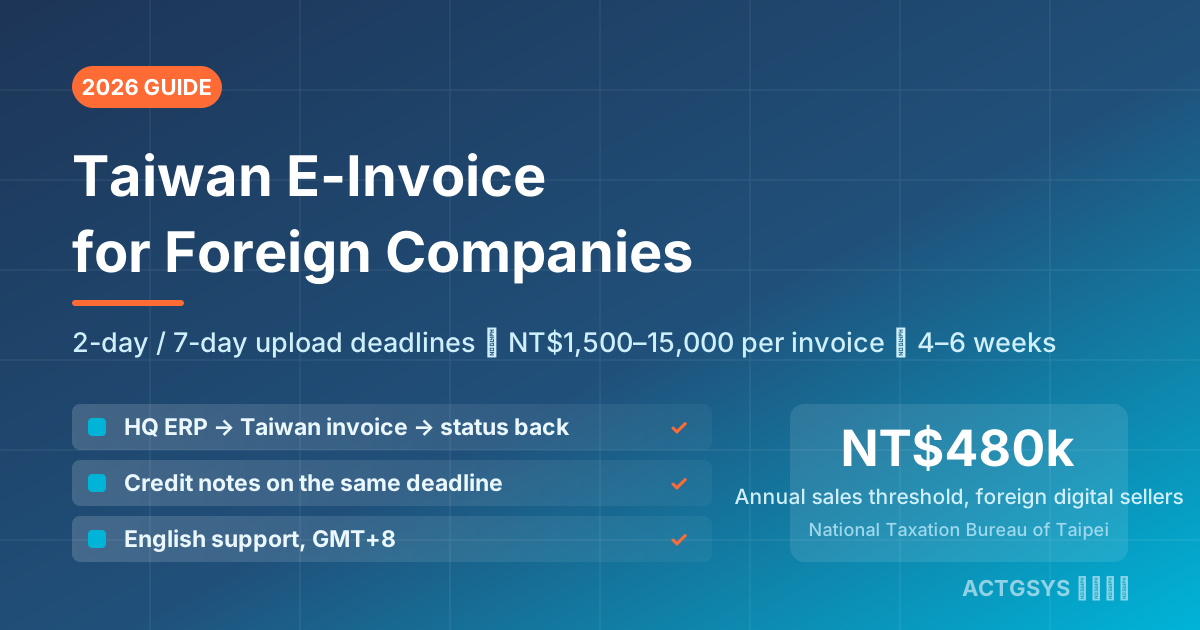
Taiwan E-Invoice for Foreign Companies 2026 - Cost
How a foreign-owned Taiwan subsidiary or branch connects its ERP to Taiwan's e-invoice platform: 2-day B2C / 7-day B2B upload deadlines, NT$1,500–15,000 per-invoice penalties, three integration paths, and a 4–6 week project from NT$50,000.
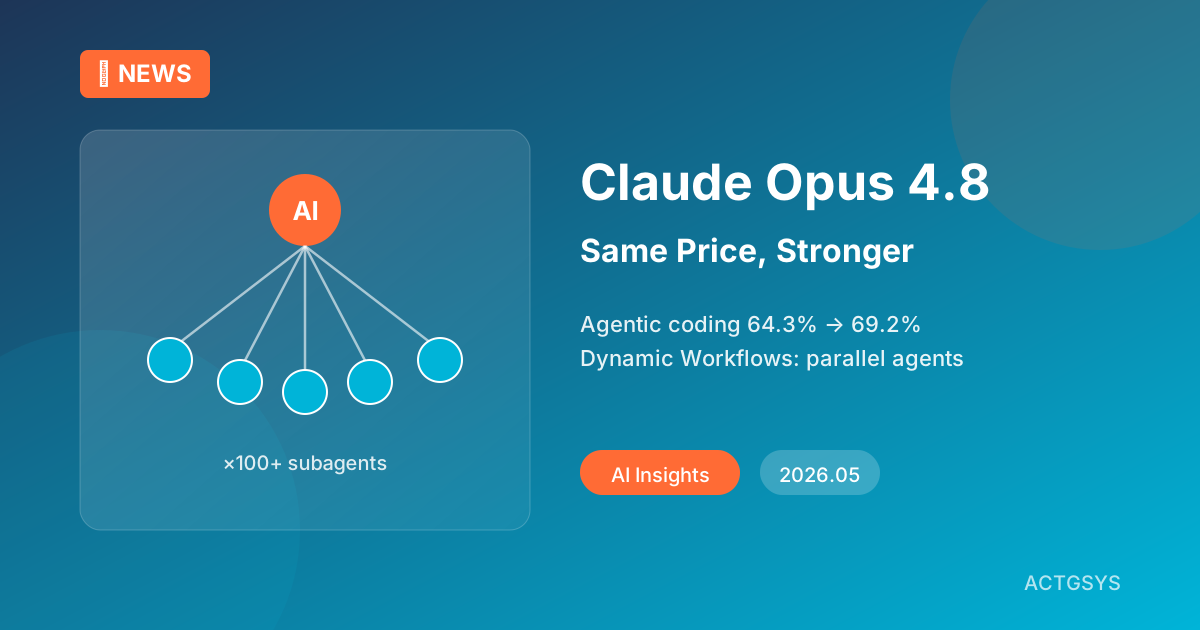
Anthropic Claude Opus 4.8 (2026): Same Price, Stronger
On May 28, 2026, Anthropic launched Claude Opus 4.8, holding the same $5 / $25 per 1M token pricing as its predecessor while lifting agentic coding from 64.3% to 69.2% and adding Dynamic Workflows — a research preview that orchestrates hundreds of parallel subagents. We unpack what this upgrade means for Taiwan SME automation.
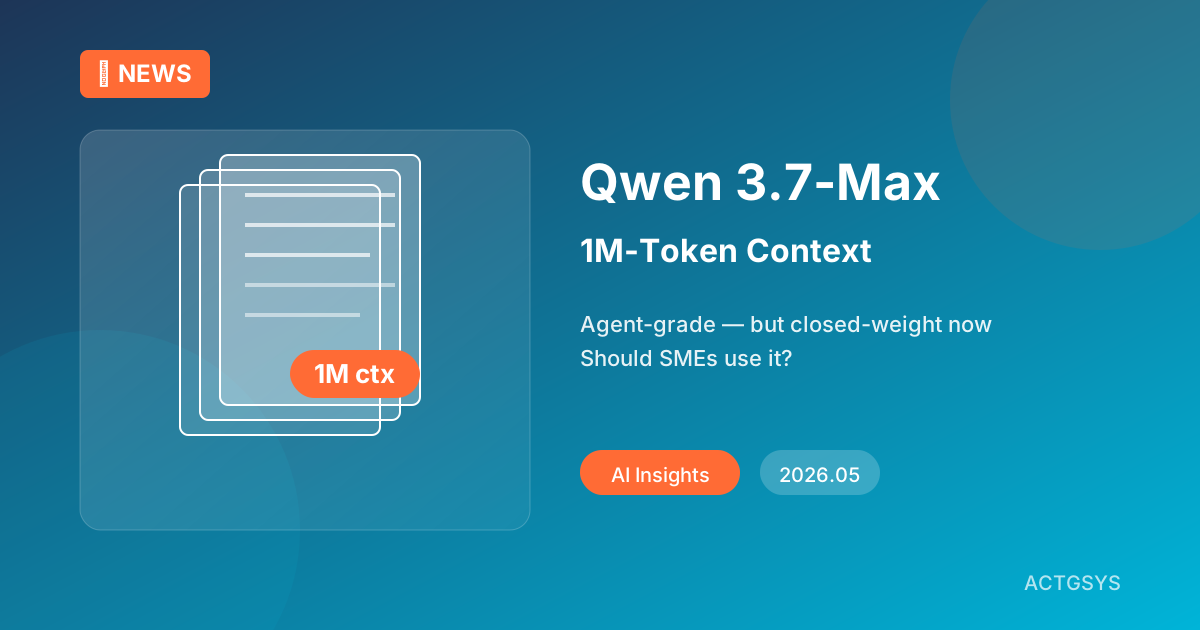
Alibaba Qwen 3.7-Max (2026): 1M-Token Context
On May 20, 2026, Alibaba launched Qwen 3.7-Max with a 1M-token context window and native extended thinking, scoring 69.7 on Terminal-Bench 2.0 and 60.6 on SWE-Bench Pro — but it's closed-weight and API-only for the first time. We unpack what this Chinese flagship means for Taiwan SME long-document processing and cost.
What would this cost you?
Answer five questions. Within three working days you get a price range and what it covers. No deck, no follow-up sales calls.
Prefer to talk?LINE·02-2553-8084