Taiwan E-Invoice for Foreign Companies 2026 - Cost
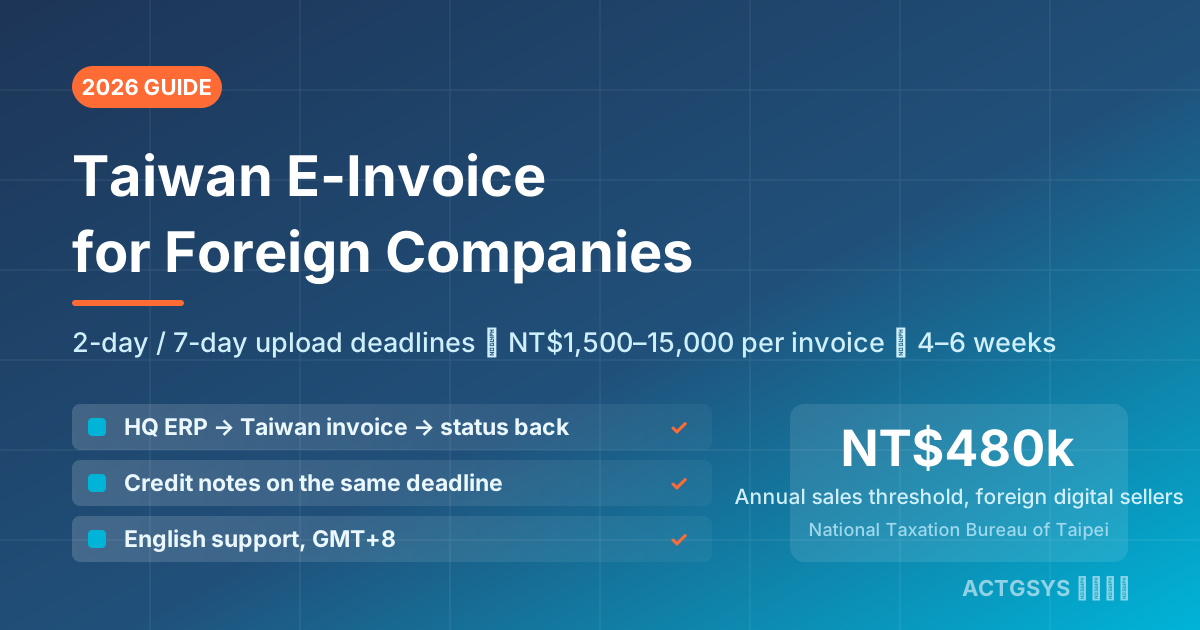
TL;DR: If your Taiwan subsidiary, branch or cross-border e-commerce business issues electronic uniform invoices, every invoice must be uploaded to the Ministry of Finance platform within 2 days (consumer sales) or 7 days (business sales), and late or inaccurate uploads carry a NT$1,500–15,000 penalty per instance since 1 January 2025. Connecting your ERP, POS or web shop so this happens automatically is a 4–6 week project, NT$50,000–150,000 for a single system; the platform itself and the value-added center fees are separate and small. The part that stretches timelines is not the API — it is credit notes, voids and reconciliation with the ERP your headquarters already runs.
This article is written for the finance manager, country manager or HQ IT lead of a foreign company that operates in Taiwan — a sales subsidiary, a sourcing office, a branch, or an online business selling to Taiwanese customers. It answers three questions in order: when the obligation applies to you, what the integration paths and costs are, and what to prepare before asking for a quote. Regulatory facts link to the primary Chinese-language sources (the Ministry of Finance and Taiwan's national law database) because no English translation is authoritative; ACTGSYS figures are our published price tiers, not market averages.
When does the e-invoice obligation apply to a foreign company?
The trigger is not your nationality or your size. It is whether your Taiwan entity issues electronic invoices at all — and, increasingly, whether your customers and platforms leave you any choice. Taiwan's Government Uniform Invoice (GUI) system requires most business-tax-registered sellers to issue an invoice for every sale; the electronic form (eGUI) is what the market has moved to, and it comes with statutory upload deadlines.
Three rules matter for a foreign-owned operation:
- Once you issue e-invoices, the deadlines apply. Under Article 32-1 of the Value-added and Non-value-added Business Tax Act (Chinese), a seller issuing invoices electronically must transmit the invoice and its required data to the Ministry of Finance E-Invoice Platform within the prescribed time limit: 2 days where the buyer is a consumer, 7 days where the buyer is a business. Article 48-2 sets the penalty at NT$1,500 to NT$15,000 per instance for late or inaccurate transmission, applied repeatedly if not corrected, in force since 1 January 2025 (Ministry of Finance press release, 18 Dec 2024, Chinese). The same deadlines apply to allowance (credit) notes for returns and discounts; the grace period for those ended 30 June 2025.
- Cross-border digital services have their own trigger. A foreign operator selling electronic services to individuals in Taiwan must register for business tax and issue cloud invoices once annual sales exceed NT$480,000, per the National Taxation Bureau of Taipei's guidance for foreign e-commerce operators (Chinese). Cloud-invoice issuance has been mandatory for registered operators since 2019, with enforcement from 2020. The e-invoice platform keeps a public list of registered foreign operators — 186 companies as of August 2026.
- Very small sellers may be exempt from invoices altogether. A small-scale business with monthly sales under NT$200,000 may be exempt from issuing uniform invoices and taxed on an assessed basis instead (Ministry of Finance, Chinese). Almost no foreign-owned subsidiary falls under this threshold, but a newly registered representative-office-turned-branch sometimes does in its first months.
In practice the obligation arrives from the market before it arrives from the tax office: Taiwanese B2B customers ask for e-invoices with their tax ID so they can claim input VAT, marketplaces require it to list, and consumers expect the invoice on their mobile barcode carrier so it enters the bi-monthly invoice lottery. A subsidiary that still issues paper invoices from a manual system is not illegal; it is simply losing deals and paying an administrator to do what a connection would do.
What is different for a foreign-owned entity?
Four things, and none of them are in the API documentation. The MIG format (the platform's XML message standard, currently version 4.0) is the same for everyone; what differs is where the data comes from and who owns the process.
- The invoice must be issued by the Taiwan entity, with Taiwan-specific fields. Buyer tax ID (統一編號) for B2B, carrier type and code for B2C (mobile barcode, citizen digital certificate), donation codes, and invoice numbers drawn from number ranges the entity is allocated every two months. Headquarters' ERP has none of these fields by default.
- The source of truth is usually abroad. Orders and revenue live in NetSuite, SAP Business One, Dynamics or Odoo at HQ; the invoice has to be issued in Taiwan and its status has to flow back. The integration is two-way, and the reconciliation between HQ revenue and Taiwan invoices is where finance audits spend their time.
- Returns and discounts are not exceptions. A credit note (allowance) has the same upload deadline as an invoice. If HQ processes returns weekly in batch, Taiwan will be late every week.
- Someone in Taiwan has to be able to operate it. Number-range applications, platform certificates, test-to-production cutover and the reply to a tax-office correction notice all happen in Chinese, in GMT+8. The vendor you choose needs to do that for you, not hand you a manual.
Three integration paths, and what each costs
The paths differ by who maintains the message format and who talks to the Ministry platform on your behalf — not by API fields. All three land on the same MIG standard published by the E-Invoice Platform (Chinese).
| Path | Who maintains the format | Fee structure | Best for | Representative timeline |
|---|---|---|---|---|
| A. Direct to the Ministry platform (Turnkey) | You, or your system vendor | The platform charges nothing; you carry long-term maintenance of MIG versions, certificates and transmission | Entities with in-house IT, high volumes, no per-invoice fees wanted | 2–4 weeks for application and environment; development depends on the system |
| B. Through a value-added center (VAC) API | The VAC | Setup fee plus an annual or per-invoice fee, published on each VAC's site | The large majority of SMEs and subsidiaries | 1–2 weeks to activate the VAC account; ERP/POS integration is separate |
| C. A module built into your ERP or POS | The system vendor | Included in the licence or sold as a module | Systems that already support it and standard flows | Days to weeks, but credit-note and void flows must be checked one by one |
The cost splits into two layers. The platform or VAC fees are recurring and small; the integration into your system is the one-time project and the real budget line.
| Item | Nature | Public range (checked Sept 2026) | Source |
|---|---|---|---|
| Ministry Turnkey | Recurring | No platform fee; maintenance staffing is yours | E-Invoice Platform |
| VAC setup fee | One-time | NT$3,600 new customer, NT$0 on renewal (excl. VAT), ECPay as the published example | ECPay e-invoice fee page |
| VAC annual service fee | Recurring | NT$3,600 for 5,000 invoices/yr, NT$6,000 for 20,000, NT$12,000 for 120,000 (excl. VAT); new customers NT$0 for the first 20,000 in year one, offer valid to 31 Dec 2026 | same |
| Integrating one system (ERP, POS or web shop) | One-time | NT$50,000–150,000 | ACTGSYS public tiers |
| Integrating several systems with one reconciliation (POS + web shop + HQ ERP) | One-time | NT$200,000–500,000 | same |
| Operations subscription after go-live | Recurring | NT$5,000–15,000 per month | same |
ECPay is cited as a published example; other value-added centers price similarly but not identically — check each provider's own page. ACTGSYS does not resell or take commission from any VAC.
Want to know where your entity lands? Answer five questions — headcount, industry, the systems you run today, the workflow you most need fixed, and your target go-live — and within 3 working days you get a price range with the scope it assumes, in English, from the team that would build it. No slide deck, no follow-up sales calls. 👉 Get your integration estimate
Why the same request can cost three times more
Four variables decide whether "connect our ERP to e-invoice" lands at NT$50,000 or NT$150,000, and none of them is the number of invoices.
- B2B versus B2C mix. Pure B2B needs buyer tax IDs and the 7-day deadline. B2C adds carriers, donation codes, lottery notifications and the 2-day deadline — roughly twice the message types.
- Credit notes, voids and cross-period corrections. Whether a return becomes an allowance note or a void-and-reissue, and how a prior-period error is corrected, must be written down before it can be coded. Most delays start here.
- How many systems, and which is the source of truth. One Taiwan-side system is one integration. HQ ERP plus a local POS plus a web shop is three, and the question of which one issues the invoice determines the design. Our guide to integrating CRM, ERP and AI covers why integration count dominates every quote.
- Historical reconciliation. An entity that has issued e-invoices for two years without matching them to shipments may need more hours on clean-up than on the integration itself.
A representative project for a foreign-owned subsidiary
The following is a representative implementation scenario compiled by ACTGSYS from projects of this type; the company is anonymised and the figures are indicative ranges, not audited numbers for a specific client.
A 12-person Taiwan distribution subsidiary of a European industrial brand runs its orders and revenue in the group's NetSuite. Invoices were issued by a Taipei administrator who re-keyed each shipment into a value-added center's web portal — about 400 invoices a month, all B2B, with returns handled as a spreadsheet and credited at month-end. Two problems drove the project: allowance notes were routinely uploaded late after the June 2025 grace period ended, and HQ finance could not reconcile Taiwan revenue to issued invoices without a manual export. Delivered by our Taipei team in five weeks: NetSuite order and return events pushed to a lightweight Taiwan-side service, invoices and allowance notes issued through the VAC API, and invoice numbers plus platform status written back to the NetSuite transaction.
| Metric | Before | After |
|---|---|---|
| Invoice issuance | Re-keyed from NetSuite, 1–2 days after shipment | Issued at shipment confirmation, uploaded the same day |
| Allowance notes for returns | Month-end batch, routinely late | Issued when the return is approved |
| Failed uploads | Discovered at month-end | Same-day queue with a fix-and-resend action |
| HQ reconciliation | Manual export, about 2 working days per month | Invoice number and status on the NetSuite record; exceptions about 1 hour |
| English-language visibility for HQ | None | Dashboard and monthly exception report |
The lesson is the same one we draw from multi-channel retailers (retail chain case): let every sales event land in one place first, then have that one place issue the invoice. Two systems issuing invoices means two number ranges, two reconciliations and twice the exceptions.
Five things to prepare before you ask for a quote
Our estimate form asks five questions; here is how to answer them for an e-invoice project.
- Headcount — who issues invoices today, in how many locations or channels, and whether HQ users need read access.
- Industry — state whether sales are B2B, B2C or both, and the monthly invoice volume.
- Current systems — the HQ ERP (NetSuite, SAP B1, Dynamics, Odoo…), any Taiwan-side POS or web shop, and whether you already have a VAC account or Turnkey setup.
- The workflow you most need fixed — pick one of "late uploads", "credit notes and voids", or "reconciliation with HQ".
- Target go-live — 4–6 weeks is realistic for a single system; if you already hold a correction notice from the tax office, say so.
Frequently asked questions
Does a foreign company have to use Taiwan's e-invoice system?
If your Taiwan entity is registered for business tax and issues invoices electronically, the upload deadlines and penalties apply exactly as they do to a local company. A foreign operator selling digital services to Taiwanese consumers must register and issue cloud invoices once annual sales exceed NT$480,000. Paper invoices remain legal for many businesses, but B2B customers and marketplaces increasingly require electronic ones. Confirm your specific position with your Taiwan tax adviser.
Can our headquarters' ERP issue the Taiwan invoice directly?
Technically yes via the Turnkey path, but it is rarely the right design: the HQ system would need Taiwan-specific fields, bi-monthly number ranges, certificates and MIG version maintenance, all operated from abroad. The usual design keeps HQ as the source of orders and revenue, issues the invoice through a Taiwan-side connection to a VAC, and writes the invoice number and status back to the HQ record.
How long does the integration take?
Four to six weeks for a single system: one to two weeks for application, number ranges and test-environment access; two to three weeks to build and validate invoice, void, allowance and cancellation messages in the test environment; one week of parallel running in production. Activating a VAC account takes one to two weeks but only gives you credentials — it does not make your system issue invoices.
What does it cost?
Two layers. VAC fees are small and recurring — with ECPay's published pricing as the example, NT$3,600 setup and NT$3,600–12,000 per year excluding VAT, with a first-year offer for new customers; the Ministry's Turnkey path has no platform fee but you maintain it. Integrating your own ERP, POS or web shop is a one-time project: ACTGSYS's public tiers are NT$50,000–150,000 for one system and NT$200,000–500,000 for several systems with one reconciliation, plus NT$5,000–15,000 per month for operations.
Will we get support in English?
Yes. Estimates, project communication and documentation are in English from the Taipei team that builds and operates the integration, working GMT+8. The Chinese-language parts — number-range applications, platform certificates, and any correspondence with the tax office — are handled by us on your behalf, with the English summary in your monthly exception report.
Conclusion
Taiwan's e-invoice system is one of the few compliance projects that, done once, removes a recurring task every month. Its difficulty was never the API. It is whether credit notes, voids, offline sales and reconciliation with headquarters have been thought through before anyone writes code — and whether the vendor can operate the Chinese-language side for you afterwards. Get those settled and a four-to-six-week project is realistic; leave them open and the penalty notices will find the gaps for you.
Last updated: 2026-09-09. NT$ ranges for ACTGSYS are our published tiers and representative project outcomes, not market averages; value-added center prices are as published on their own sites; regulatory content is summarised from the Ministry of Finance and Taiwan's national law database and is not tax advice.
Want an estimate for your entity's invoice volume and systems? Answer five questions and get a price range with its scope within three working days. Prefer to talk first? LINE Official Account, phone +886-2-2553-8084 (Mon–Fri 10:00–18:00 GMT+8), or email info@actgsys.com.
Want to see how this applies to your company?
Products & Solutions in This Article
Related Articles
AI Cross-Border Ecommerce Playbook for SMEs (2026)
How Taiwan SMEs use AI to automate cross-border e-commerce — multilingual listings, smart customer service, dynamic pricing, ad ops, and logistics forecasting across Amazon, Shopify, Shopee, Lazada, and TikTok Shop.
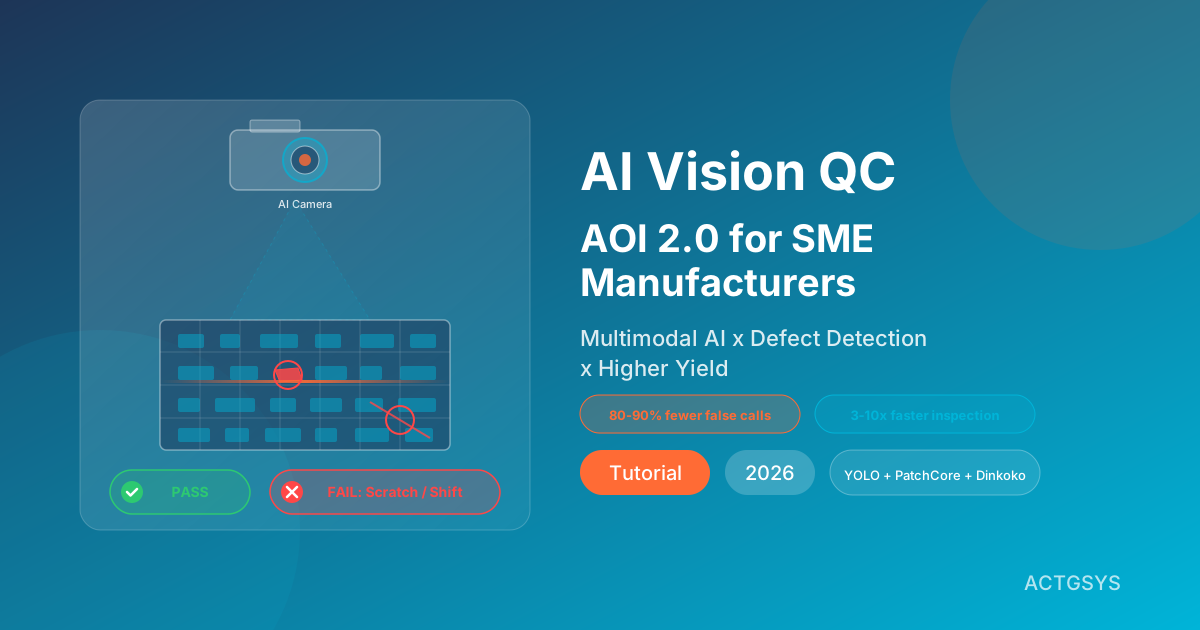
AI Vision Quality Control 2026: AOI 2.0 for SMEs
A deep dive into how AI vision QC (AOI 2.0) combines computer vision with multimodal LLMs to automate defect detection, raise yield and shrink inspection time. Includes a five-step rollout, platform comparison and FAQ.
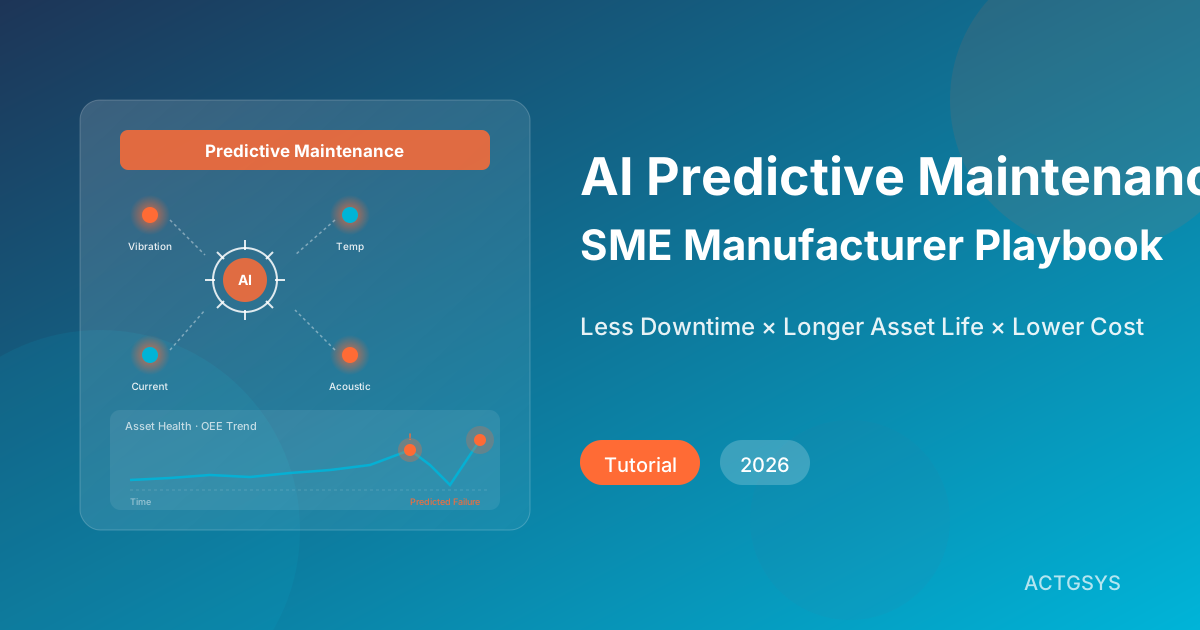
AI Predictive Maintenance for SME Manufacturers
What is AI predictive maintenance? This 2026 guide for SME manufacturers explains the IoT + edge AI architecture, a six-step rollout, and a side-by-side platform comparison, with citations from McKinsey, Deloitte, NVIDIA, AWS, and Taiwan's ITRI.
What would this cost you?
Answer five questions. Within three working days you get a price range and what it covers. No deck, no follow-up sales calls.
Prefer to talk?LINE·02-2553-8084