Alibaba Qwen 3.7-Max (2026): 1M-Token Context
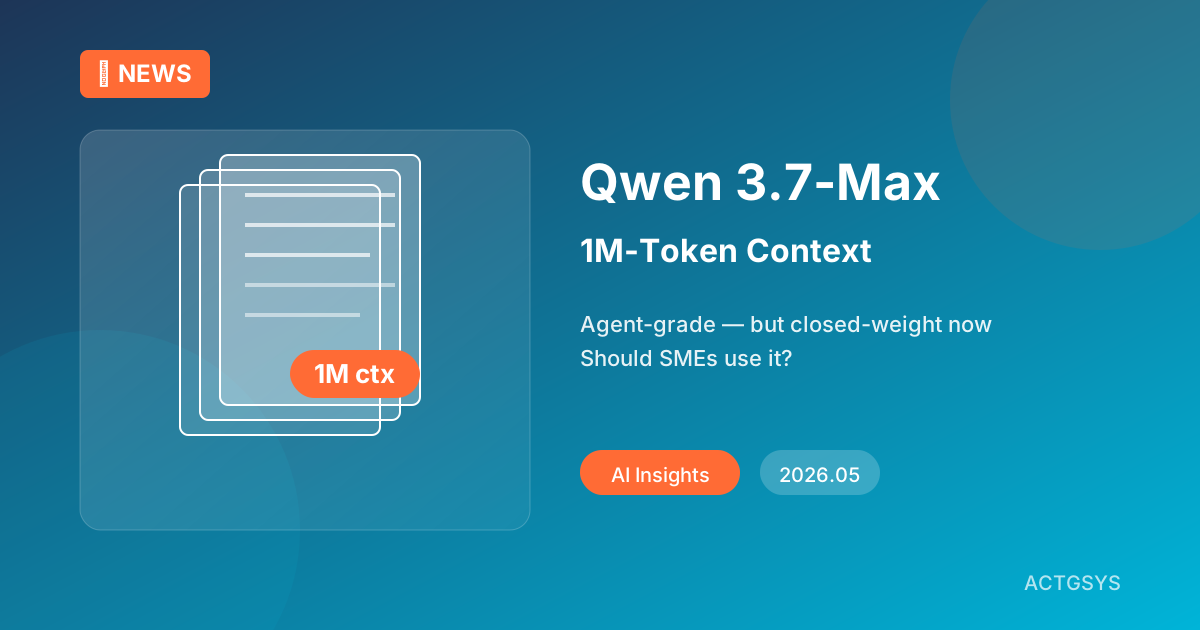
On May 20, 2026, Alibaba officially launched its flagship model Qwen 3.7-Max at the Alibaba Cloud Summit, doubling the context window from the previous 256K to 1 million tokens, with native extended thinking and agent-grade capabilities — but unlike Qwen's open-source tradition, this is its first closed-weight, API-only release. For Taiwan SMEs, the standout isn't the benchmarks — it's the "1M-token context," which makes "feeding in an entire contract, an entire manual, or a full quarter's reports at once" genuinely practical.
What Happened With Qwen 3.7-Max?
Alibaba officially launched Qwen 3.7-Max at the Alibaba Cloud Summit on May 20, 2026, with the commercial API going live a day earlier (May 19) on Alibaba Cloud Model Studio. According to the official Qwen blog (2026) and third-party coverage, the biggest leap is the context window — doubling from the previous Qwen3.6 Max's 256K to 1 million tokens, with a built-in native extended-thinking mode (MarkTechPost, 2026).
The point Taiwan readers should note most: Qwen 3.7-Max is closed-weight and API-only for the first time. Alibaba has long been known for its open-source Qwen series (many model weights are public on HuggingFace), but this flagship has not released weights as of May 2026 and is usable only via Alibaba Cloud's DashScope / Model Studio. For enterprises that value "self-hosting, keeping data in-country," this is a constraint to think through first.
What Are the Key Improvements in Qwen 3.7-Max?
Qwen 3.7-Max is positioned as a "reasoning + agent" model, focused on three areas:
- 1M-token context window — doubled from the previous 256K, it can process an entire long contract, a full product manual, or a quarter's financials in one pass, without chunking and multiple feeds.
- A clear jump in overall intelligence — it scored 56.6 on the Artificial Analysis Intelligence Index, ranking fifth overall, a 4.8-point gain over its predecessor Qwen3.6 Max (51.8); CritPt rose 9.7 points and Humanity's Last Exam jumped 9.2 points (MarkTechPost, 2026).
- Strong agent and coding ability — 69.7 on Terminal-Bench 2.0, 60.6 on SWE-Bench Pro, and 76.4 on MCP-Atlas, top-tier among Chinese models; its Arena text Elo reached 1,475, ranking #13.
How Is Qwen 3.7-Max Different From DeepSeek and the Previous Version? (Context and Capability)
The most-searched query for news like this is "Qwen vs DeepSeek." The table lays out the key points:
| Dimension | Qwen 3.6 Max (prev) | Qwen 3.7-Max | DeepSeek V4-Pro |
|---|---|---|---|
| Context window | 256K | 1M tokens | Shorter |
| Open-weight | Partly open | No (closed, API-only) | Yes (weights public) |
| Agent / coding | Weaker | SWE-Bench Pro 60.6, Terminal-Bench 2.0 69.7 | SWE-bench Verified 80.6% |
| Access | API / partial self-host | Alibaba Cloud API only | API or self-host |
(Sources: official Qwen blog, MarkTechPost, Artificial Analysis, 2026. Benchmarks use each vendor's reported tests, not a single identical baseline — directional comparison only.)
The key takeaway: Qwen 3.7-Max's biggest differentiator is "ultra-long context," not "strongest coding." On pure coding, DeepSeek V4-Pro's SWE-bench still leads; but if your pain point is "documents too long to fit at once," the 1M-token context is Qwen 3.7-Max's key selling point. The other major difference is open-weight — DeepSeek can be self-hosted to keep data in-house, while Qwen 3.7-Max is currently Alibaba Cloud API only.
Pricing note: As of launch, official API pricing for Qwen 3.7-Max had not been fully announced (the predecessor Qwen3.6 Max was roughly $1.30 input / $7.80 output per 1M tokens; some third-party trackers report the new version around $2.50 / $7.50). For actual costs, rely on Alibaba Cloud Model Studio's official pricing.
How Are Developers and the Industry Reacting?
Community reaction splits between "long context is genuinely useful" and "closed-weight is surprising."
Positive reactions center on long context + value — developers broadly agree the 1M-token context makes long-document Q&A, whole-codebase comprehension, and long-conversation memory practical, and strong Chinese-language performance has always been a Qwen strength, especially friendly for enterprises processing Chinese data.
Reservations center on the closed-weight pivot and data governance — Qwen has long been known for open source, so this flagship's first closed-weight release surprised many developers and erodes the past core advantage of "self-host, keep data in-house." Some enterprise users have compliance concerns about "sending data to a China-based cloud," especially for apps touching customer PII and financial data.
In the broader frame, this echoes Gartner's read on 2026: ultra-long context windows are becoming a key competitive dimension for enterprise AI, because they directly determine "whether you can process complete enterprise documents and knowledge bases at once" (Gartner, 2025). But Gartner also cautions that model selection must fold in data sovereignty and compliance.
What Does This Mean for Taiwan SMEs?
For Taiwan SMEs, Qwen 3.7-Max is a strong new option for "long-document / long-context apps" — but closed-weight and data residency are prerequisites to settle first.
Opportunities:
- Long-document processing becomes practical — the 1M-token context lets you "feed in an entire contract, full SOP, or quarter's reports at once for Q&A and summarization" without complex chunking engineering, ideal for document-heavy industries.
- Friendly Chinese-language performance — the Qwen series has long performed well in Chinese understanding and generation, well-suited to Taiwan firms handling Chinese customer data, contracts, and service logs.
- A strong complement to RAG — ultra-long context can reduce reliance on complex retrieval architectures; in some cases you can "stuff the full text in and ask," simplifying system design.
Three cautions:
- Closed-weight = no self-hosting — currently Alibaba Cloud API only, with no way to move the model in-house or to a neutral cloud. For apps touching customer PII, finance, or trade secrets, confirm data flow and compliance first.
- Assess data sovereignty first — if your core apps touch sensitive data with in-country requirements, Qwen 3.7-Max's API-only limit may rule it out, making open, self-hostable DeepSeek a better fit.
- Pricing not yet clear — official API pricing isn't fully published; before adopting, estimate real costs with Alibaba Cloud's official quote rather than third-party numbers.
When wiring ultra-long context into TanJee for whole-document Q&A and summarization, or into Dinkoko ERP for long-report analysis, keep a model-routing layer so "long-document tasks go to Qwen 3.7-Max, sensitive data to a self-hostable open model, coding to DeepSeek," optimized by task type and compliance.
ACTGSYS Recommendation: What Should You Do Now?
Qwen 3.7-Max is worth evaluating, especially for document-heavy SMEs handling large volumes of long Chinese text — but weigh the "long-context advantage" against "closed-weight / data-residency limits."
Do now:
- Inventory "long-document / long-context" pain points — list apps stuck because "documents are too long for the AI to read at once" (contract review, long-report summarization, knowledge-base Q&A); these benefit most from 1M-token context.
- Tier your data governance — split apps into "cloud-API OK" and "must stay in-country"; evaluate self-hostable open models for the latter, Qwen 3.7-Max for the former.
- A/B test long-document scenarios — compare Qwen 3.7-Max against your current solution on your most common long-document tasks for quality and cost (using Alibaba Cloud's official quote).
Wait and watch:
- Don't move sensitive-data apps yet — for apps touching large volumes of customer PII with compliance requirements, keep the current solution given the API-only limit.
- Hold large commitments until pricing is clear — avoid big usage commitments before official pricing is fully published.
Frequently Asked Questions
Can Qwen 3.7-Max be used in Taiwan?
Yes, but only via Alibaba Cloud's DashScope / Model Studio API; model weights aren't available for self-hosting. For apps touching customer PII or financial data with in-country requirements, confirm data flow and compliance first — such cases may suit a self-hostable open model better.
Is Qwen 3.7-Max open source? How is it different from earlier Qwen?
It's not open source. Alibaba was long known for the open-source Qwen series (many weights public on HuggingFace), but Qwen 3.7-Max is its first closed-weight flagship — no weights released as of May 2026, API-only — losing the past Qwen advantage of self-hosting and keeping data in-house.
How do I choose between Qwen 3.7-Max and DeepSeek V4-Pro?
It depends on the pain point. If you need to process ultra-long documents — fitting an entire contract or manual at once — Qwen 3.7-Max's 1M-token context is the key advantage; if you want the strongest coding/software-engineering ability and need to self-host to keep data in-house, DeepSeek V4-Pro (SWE-bench 80.6%, open) fits better. The pragmatic move is to route by task type.
Can Qwen 3.7-Max's 1M-token context replace RAG?
It can simplify some scenarios but won't always fully replace RAG. Ultra-long context makes "stuff the full text in and ask" viable, easing the burden of complex retrieval; but for very large, continuously updated knowledge bases, RAG still wins on cost and freshness. Evaluate "pure long-context," "pure RAG," or "a hybrid" based on data volume and update frequency.
Conclusion
Qwen 3.7-Max's real highlight is its "1M-token ultra-long context," making long-document processing practical, with Chinese-language performance a plus for Taiwan firms. But the first closed-weight, Alibaba-Cloud-API-only pivot makes "data residency and compliance" a prerequisite to resolve before adopting. For Taiwan SMEs, the right response is to inventory long-document pain points, tier data governance, test on real tasks, and keep architectural flexibility to route different models by task.
Want an AI architecture that uses a long-context model for long documents, a self-hostable option for sensitive data, and optimizes cost and compliance by task? Contact ACTGSYS — we help Taiwan SMEs pick the right tools and hold the data-governance line in a fast-moving model market.
Event date: May 20, 2026 (Alibaba launches Qwen 3.7-Max). Last updated: May 31, 2026.
Products & Solutions in This Article
Intuitive accounting system designed for Taiwan SMEs, with automated bookkeeping and financial reporting.
AI-driven ERP focusing on procurement, inventory, and supply chain management. Each customer deployed on dedicated cloud infrastructure.
Related Articles
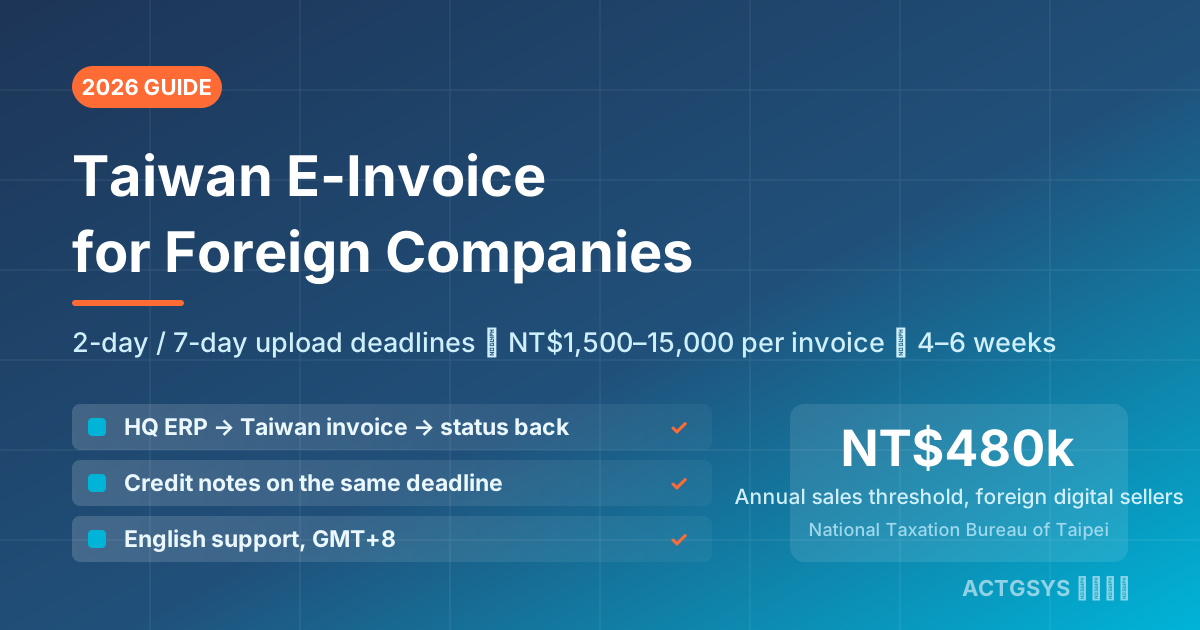
Taiwan E-Invoice for Foreign Companies 2026 - Cost
How a foreign-owned Taiwan subsidiary or branch connects its ERP to Taiwan's e-invoice platform: 2-day B2C / 7-day B2B upload deadlines, NT$1,500–15,000 per-invoice penalties, three integration paths, and a 4–6 week project from NT$50,000.
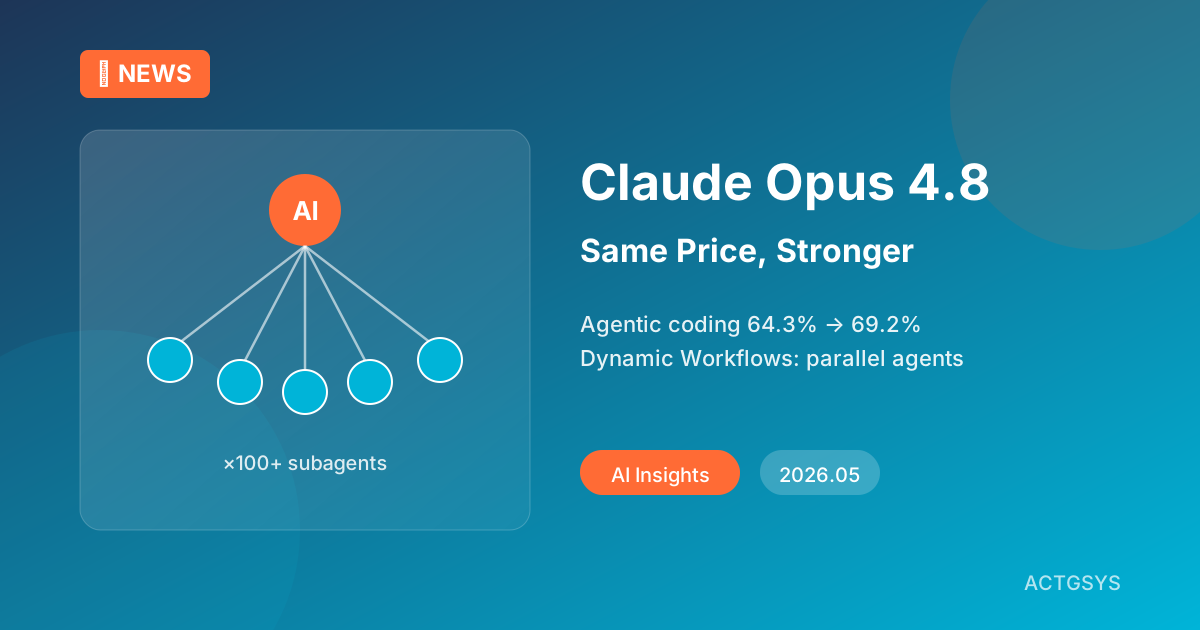
Anthropic Claude Opus 4.8 (2026): Same Price, Stronger
On May 28, 2026, Anthropic launched Claude Opus 4.8, holding the same $5 / $25 per 1M token pricing as its predecessor while lifting agentic coding from 64.3% to 69.2% and adding Dynamic Workflows — a research preview that orchestrates hundreds of parallel subagents. We unpack what this upgrade means for Taiwan SME automation.
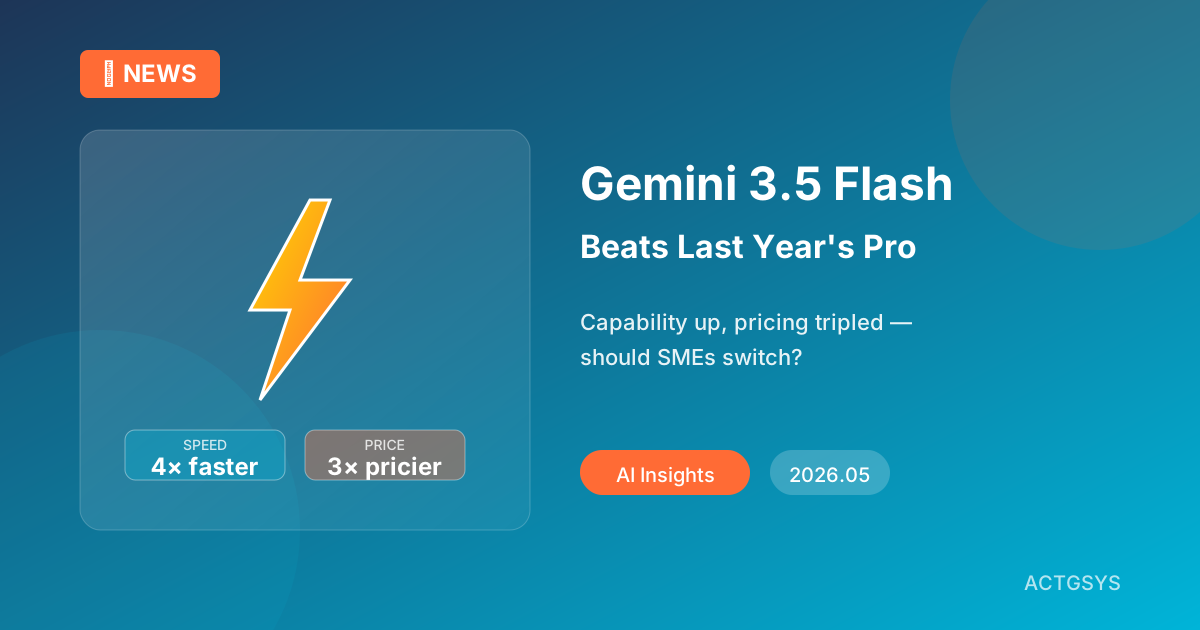
Google Gemini 3.5 Flash (2026): Flash Beats Last Year's Pro
On May 19, 2026 at I/O 2026, Google launched Gemini 3.5 Flash with coding and agentic benchmarks that beat Gemini 3.1 Pro — but API pricing tripled vs. the previous Flash. We unpack the model's strength, the pricing strategy, and what Taiwan SMEs should do.
What would this cost you?
Answer five questions. Within three working days you get a price range and what it covers. No deck, no follow-up sales calls.
Prefer to talk?LINE·02-2553-8084