Google Gemini 3.5 Flash (2026): Flash Beats Last Year's Pro
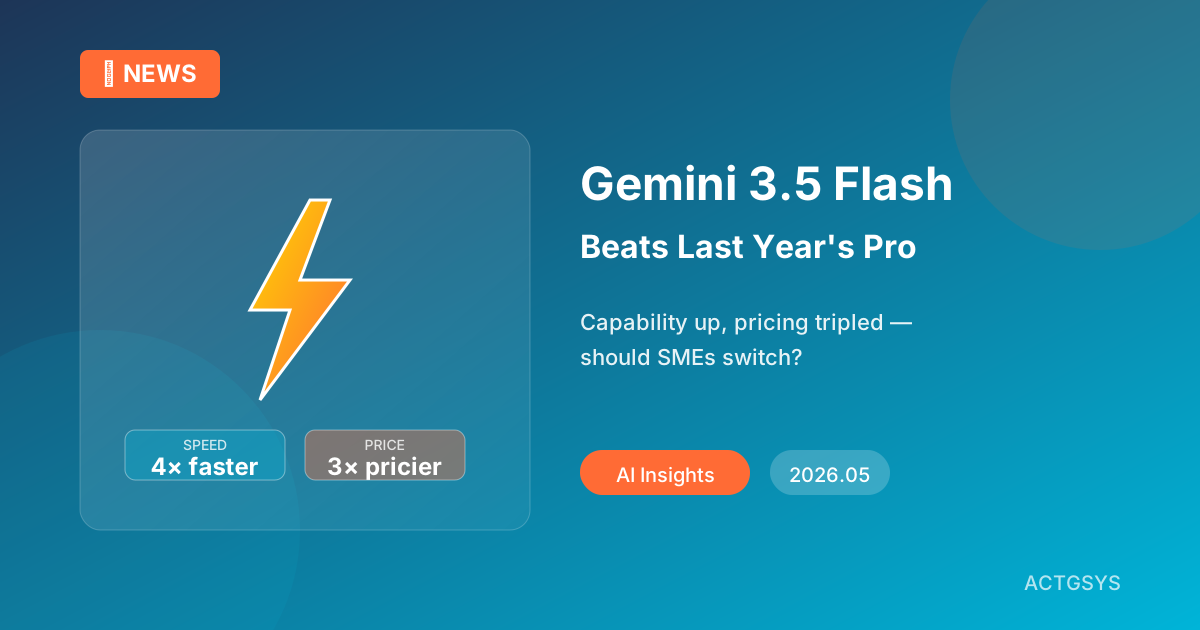
On May 19, 2026 at Google I/O 2026, Google launched Gemini 3.5 Flash — coding and agentic benchmarks beat Google's own Gemini 3.1 Pro and it runs 4x faster, but API pricing tripled compared to the previous Flash. For Taiwan SMEs, this isn't a simple "upgrade to 3.5 Flash" decision — Google is officially signaling that Flash is no longer "the cheap tier," and AI API economics are being re-shuffled.
What Did Google Announce With Gemini 3.5 Flash?
On May 19, 2026, at Google I/O 2026, Google launched Gemini 3.5 Flash — the first model in the new Gemini 3.5 family and the strongest agentic and coding model the Flash line has ever shipped. According to Google's official blog (2026), this Flash-tier model simultaneously surpasses last year's Pro-tier model on multiple benchmarks.
Two key facts: first, the new Flash beats Gemini 3.1 Pro on coding, agentic, and multimodal benchmarks. Second, API pricing is set at $1.50 / $9 per 1M tokens (input / output) — 3x the previous Gemini 3 Flash ($0.50 / $3), but still about 40% cheaper than Gemini 3.1 Pro ($2.50 / $15).
The strategic message is clear: Google no longer treats Flash as a "cheap alternative." Flash is being repositioned as the default tier for agentic-first developers. Gemini 3.5 Pro is expected next month (June 2026), but Google has already pulled Flash up to last year's Pro level.
What Are the Key Improvements in Gemini 3.5 Flash?
Based on Google's official blog and Simon Willison's hands-on notes (2026), the highlights:
- Terminal-Bench 2.1: 76.2% — terminal operation and agent task benchmark, beating Gemini 3.1 Pro (Google, 2026).
- GDPval-AA: 1656 Elo — agent evaluation metric reflecting real-world task completion.
- MCP Atlas: 83.6% — Model Context Protocol tool-use benchmark, leading its tier.
- CharXiv Reasoning: 84.2% — multimodal chart and image understanding.
- 4x faster than other frontier models — measured in output tokens per second.
- 1M token context window — handles hundreds of pages of documents or large code repos in one pass.
- Available everywhere at launch — Antigravity 2.0, Gemini API, Google AI Studio, AI Mode in Search, Gemini app.
Overall, this update isn't "Flash got cheaper" — it's "Flash became the main model." Google is re-defining Flash as the default for agentic tasks, folding workflows that previously required Pro into a faster, cheaper-than-Pro Flash tier.
How Does Gemini 3.5 Flash Compare to the Previous Flash and Pro?
The biggest shift is "the capability tiers were redrawn." Side-by-side:
| Aspect | Gemini 3 Flash (prev) | Gemini 3.5 Flash (new) | Gemini 3.1 Pro (concurrent Pro) |
|---|---|---|---|
| Input price (USD / 1M tokens) | 0.50 | 1.50 (3x) | 2.50 |
| Output price (USD / 1M tokens) | 3 | 9 (3x) | 15 |
| Context window | 1M | 1M | 1M |
| Terminal-Bench 2.1 | — | 76.2% | lower |
| MCP Atlas (tool use) | — | 83.6% | lower |
| CharXiv Reasoning | — | 84.2% | lower |
| Output speed (vs frontier) | baseline | 4x | slower |
| Best for | High-volume, low-cost tasks | Agentic, coding, multimodal | Soon to be replaced by 3.5 Pro |
For SMEs, the read-through is "volume × unit price": if you currently run Gemini 3 Flash for high-volume low-complexity tasks (summarization, classification), switching to 3.5 Flash triples your bill. If you currently use Pro for agentic, cross-tool workflows, dropping to 3.5 Flash saves about 40%. Whether the new model is "good" depends entirely on which side you're on.
How Did Developers React?
Reaction split sharply, all of it centered on the "capability vs. pricing" tension.
Positive reactions focus on capability — multiple developers have confirmed that Gemini 3.5 Flash is markedly more stable and faster on coding and agent workloads. The 4x output speed advantage over other frontier models is especially noticeable on long-loop, multi-step agentic workflows. The 83.6% on MCP Atlas tool-use also held up in independent testing — meaning external tool calls fail far less often than before.
Criticism centered on pricing and naming — Simon Willison and others pointed out clearly: calling a 3x-more-expensive model "Flash" muddies the long-standing "Flash = cheap" market signal. For pure high-volume, low-cost Flash use cases, this release is effectively "overpowered, with bills tripled," and many developers are choosing to stay on Gemini 3 Flash for now.
Pragmatist take — if you reframe Gemini 3.5 Flash as "what used to need Pro, now in Flash," the pricing is actually "40% savings." Whether that math works depends entirely on the use case.
Zooming out to industry framing, this pricing strategy aligns with Gartner's observation that enterprise AI investment is shifting from "model strength" to "cost per unit task" (Gartner, 2025). Repositioning Flash as the main tier is a clear move in that race.
What Does This Mean for Taiwan SMEs?
For Taiwan SMEs, Gemini 3.5 Flash is a "re-do the math" signal — not an "upgrade now" command.
The opportunity:
- Agentic workflows just got cheaper — auto-reply customer service, cross-tool lookups, report generation that used to require Pro-tier models can now run on 3.5 Flash, with per-task costs potentially down 30–40%.
- Multimodal capability arrives at Flash tier — 84.2% on CharXiv Reasoning means the model can read screenshots, charts, and customer-submitted images directly. For SMEs handling photo-based queries (product defect photos, invoice images), capability jumps significantly.
- 1M context window makes long-document analysis practical — fit an entire employee handbook or a year of contracts in a single request.
But watch two things:
- Audit your current usage profile — if 90% of your Gemini usage is low-complexity (basic translation, classification), jumping straight to 3.5 Flash means 3x bills for capability you don't need. Consider a routing strategy: keep low-complexity tasks on Gemini 3 Flash or other low-priced models; reserve 3.5 Flash for agentic work.
- Wait for Gemini 3.5 Pro in June before locking in — Google has confirmed 3.5 Pro is coming in June. If your use case is top-tier complexity, switching to 3.5 Flash now may miss a better option a few weeks out.
This is why ACTGSYS treats "model selection" as continuous optimization, not a one-time decision. When wiring AI into DanLee CRM or TanJee, we recommend designing in model-switching flexibility (via an abstraction layer or router), so every new model launch can be compared on cost and quality — picking the best fit rather than getting locked into one vendor's pricing.
ACTGSYS Recommendations: What Should You Do Now?
Gemini 3.5 Flash is worth evaluating but isn't a mandatory upgrade. Splitting:
Do now:
- Audit your Gemini usage mix — break the last three months of Gemini API usage into "low-complexity (translation, classification, simple summarization)" vs. "agentic / coding / multimodal," and calculate the percentage split.
- A/B test 3.5 Flash on agentic scenarios — if you already run agentic flows like auto-reply or report generation, test 3.5 Flash on a small slice of traffic for 1–2 weeks and quantify cost and quality vs. current model.
- Build a model-switching abstraction layer — add model routing capability to your own systems so different task types can hit different models. Avoid being locked into any single vendor's pricing.
- Plan a re-evaluation point in June — Gemini 3.5 Pro launches in June. If your use case is top-tier complexity, defer the full evaluation 4–6 weeks so the entire 3.5 family can be compared in one pass.
Watch and wait:
- Don't rush low-complexity tasks — if most volume is simple summarization, translation, or classification, staying on Gemini 3 Flash or evaluating other low-price models (Gemini Flash Lite, Haiku) makes more sense financially.
FAQ
Can Gemini 3.5 Flash Be Used in Taiwan?
Yes. Gemini 3.5 Flash has been available since May 19, 2026 across the Gemini app, Google AI Studio, Gemini API, Antigravity 2.0, and Google Search AI Mode — Taiwan has same-day access. For enterprise deployment, use Vertex AI to get data residency and access controls.
Is Gemini 3.5 Flash Worth Using If It's 3x More Expensive Than Gemini 3 Flash?
It depends on use case. For agentic workflows, coding, and multimodal tasks, the new version beats Pro at 40% lower cost — clearly worth it. For low-complexity tasks (basic translation, classification), the bill tripled for capability you don't need; stay on the previous Flash or evaluate other low-price models.
How Does Gemini 3.5 Flash Compare to GPT-5.5 and Claude?
No absolute answer — depends on the scenario. Long-document analysis, Google ecosystem integration, and agentic tasks favor Gemini; complex reasoning and SMB workflow integration may favor Claude; ChatGPT default experience runs on GPT-5.5 Instant. Test all three on the same real-world tasks and score them on quality / cost / integration difficulty before deciding.
When Will Gemini 3.5 Pro Launch? Should I Wait?
Google has confirmed Gemini 3.5 Pro launches in June 2026 (next month from the May 19 announcement). For top-tier complexity use cases, defer the full evaluation 4–6 weeks to avoid switching twice in a short window.
Closing Thoughts
The real signal in Gemini 3.5 Flash isn't "Flash got stronger" — it's that AI API economics are being re-shuffled. Flash no longer means cheap; Pro no longer means necessary. For Taiwan SMEs, the right response isn't to switch immediately — it's to re-do the math on your own usage, build switching flexibility into your stack, and wait for June to see the full picture.
Looking to design an AI architecture that flexibly switches between models, optimizes cost per task type, and preserves vendor optionality? Contact ACTGSYS — we help Taiwan SMEs build long-term strategies that capture each new model's upside without getting locked in.
Event date: May 19, 2026 (Gemini 3.5 Flash launched at Google I/O 2026). Last updated: May 25, 2026.
Products & Solutions in This Article
AI-powered CRM for lead management, customer tracking, and sales pipeline optimization designed for SMEs.
Intuitive accounting system designed for Taiwan SMEs, with automated bookkeeping and financial reporting.
Related Articles
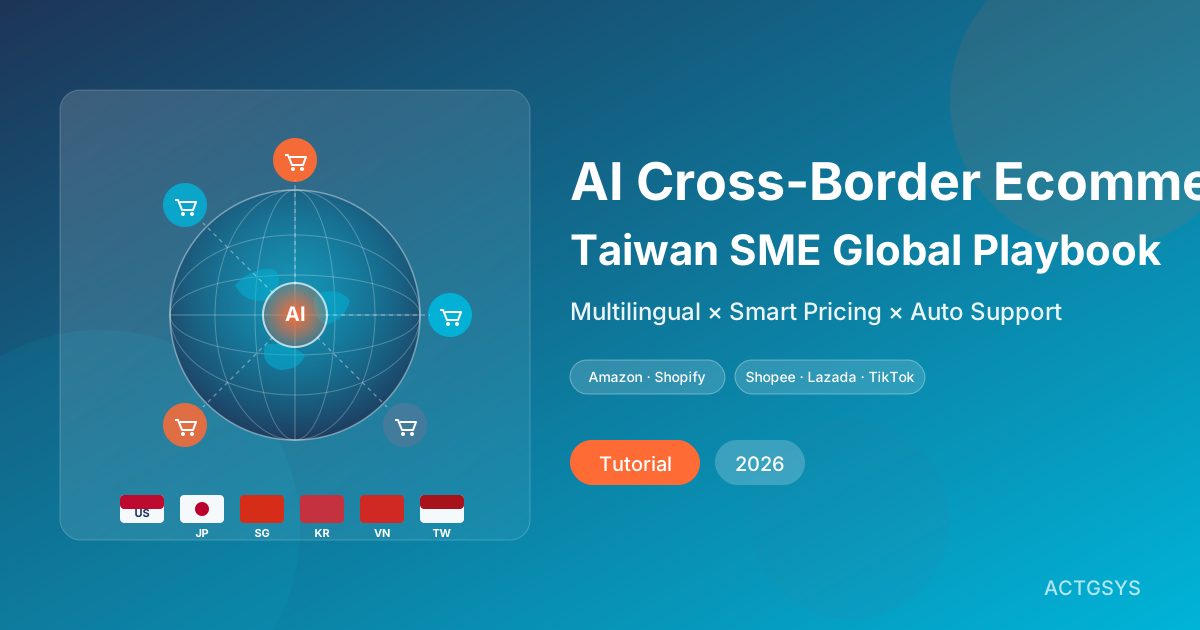
AI Cross-Border Ecommerce Playbook for SMEs (2026)
How Taiwan SMEs use AI to automate cross-border e-commerce — multilingual listings, smart customer service, dynamic pricing, ad ops, and logistics forecasting across Amazon, Shopify, Shopee, Lazada, and TikTok Shop.
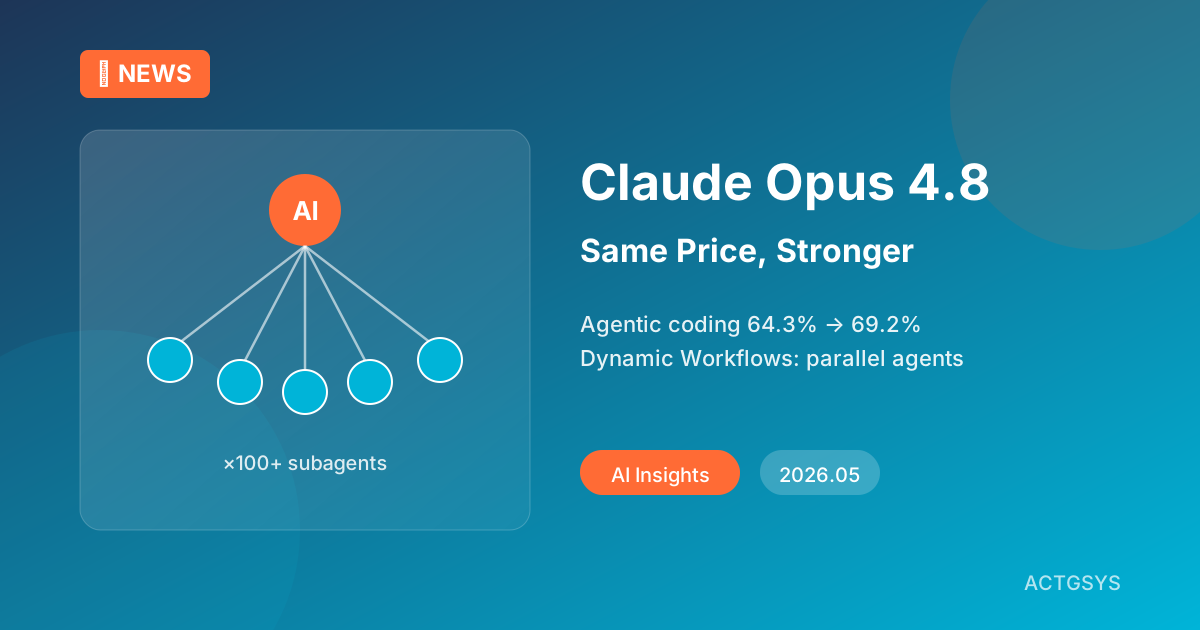
Anthropic Claude Opus 4.8 (2026): Same Price, Stronger
On May 28, 2026, Anthropic launched Claude Opus 4.8, holding the same $5 / $25 per 1M token pricing as its predecessor while lifting agentic coding from 64.3% to 69.2% and adding Dynamic Workflows — a research preview that orchestrates hundreds of parallel subagents. We unpack what this upgrade means for Taiwan SME automation.
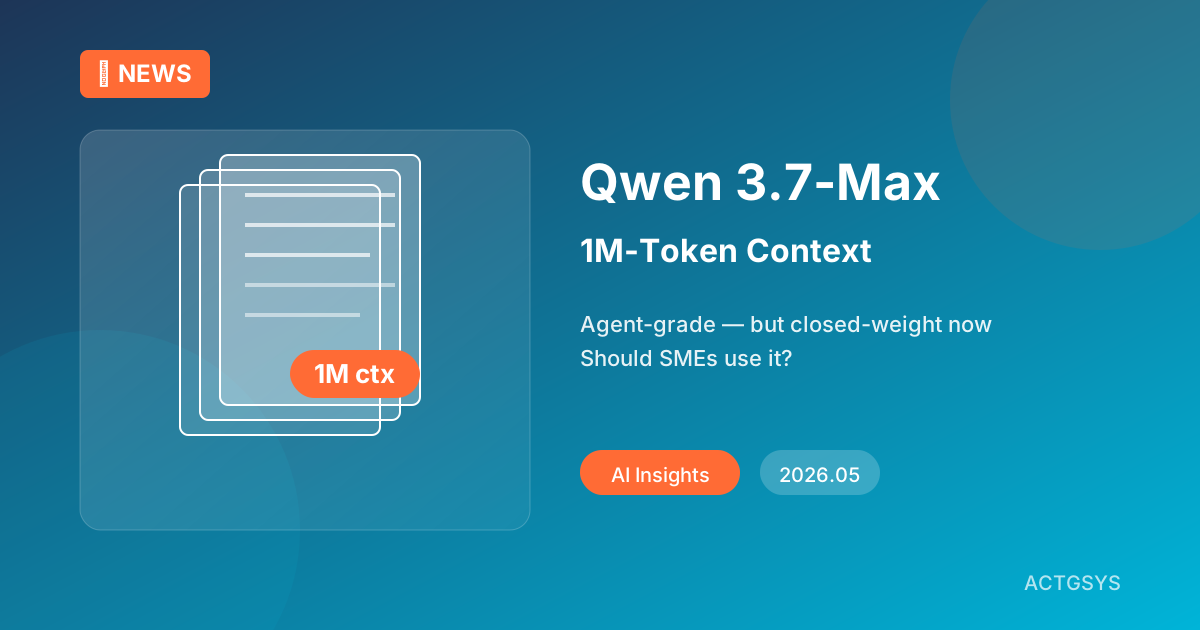
Alibaba Qwen 3.7-Max (2026): 1M-Token Context
On May 20, 2026, Alibaba launched Qwen 3.7-Max with a 1M-token context window and native extended thinking, scoring 69.7 on Terminal-Bench 2.0 and 60.6 on SWE-Bench Pro — but it's closed-weight and API-only for the first time. We unpack what this Chinese flagship means for Taiwan SME long-document processing and cost.
What would this cost you?
Answer five questions. Within three working days you get a price range and what it covers. No deck, no follow-up sales calls.
Prefer to talk?LINE·02-2553-8084