Camunda ProcessOS (2026): Turning Business Processes Into AI Agent Workflows
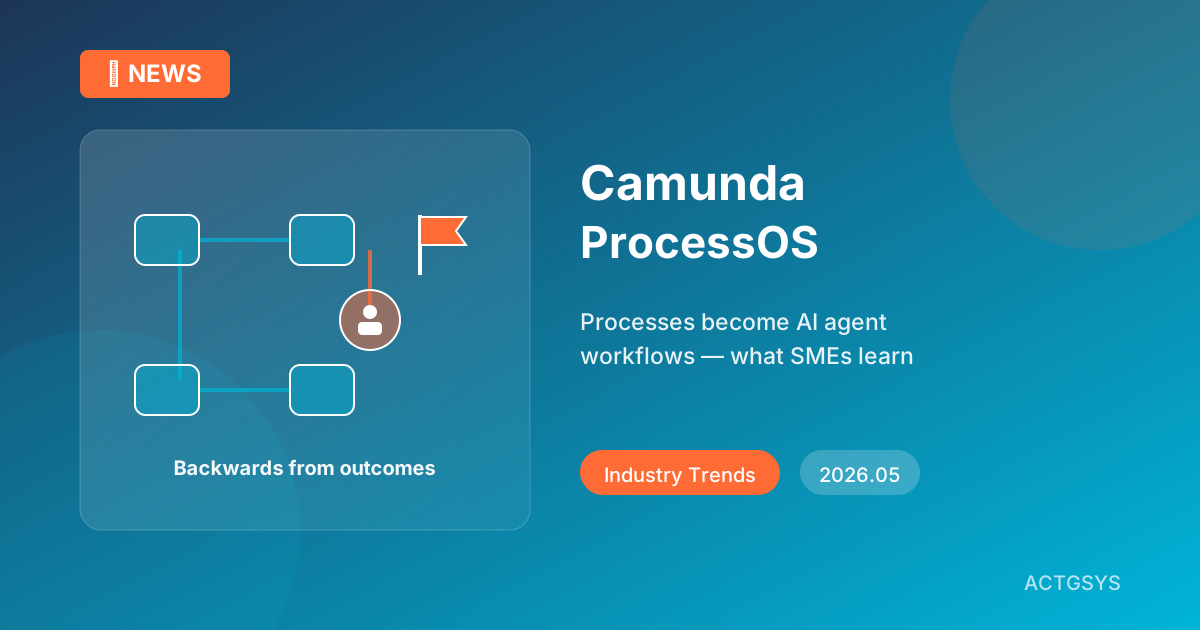
On May 20, 2026, at its annual CamundaCon, Camunda launched ProcessOS — an AI agent intelligence layer that automatically discovers, re-engineers, and continuously optimizes business processes, now in closed beta. For Taiwan SMEs, the value of this launch isn't "adopt this tool now" (it's heavy and only pencils out at scale) — it's the key idea it lays bare: AI-era process transformation must "work backwards from outcomes," not just digitize your existing broken processes as-is.
What Happened With Camunda ProcessOS?
On May 20, 2026, Camunda launched ProcessOS at its annual CamundaCon — billed as the largest global agentic orchestration conference, with 1,200 enterprise leaders and technologists from 25 countries in attendance. According to Camunda's official press release (2026), ProcessOS is a new "intelligence layer" for its agentic orchestration platform, available in closed beta as of May 20.
ProcessOS's core definition: an AI-powered intelligence layer that "discovers, re-engineers, and continuously optimizes" a company's business processes, turning them into agentic workflows. It uses the latest agentic software-development advances to generate and modify full process-based solutions — including agentic processes, integrations, data mapping, agent prompts, decisions, and UI forms — drawing on a growing catalog of extensions on the Camunda marketplace.
Technically, ProcessOS runs natively on AWS, with deep integration into Amazon Bedrock and Amazon Bedrock AgentCore for foundation models, agent memory, identity, and gateway services. Camunda's partnership with AWS was also recognized with the Rising Star Technology Partner of the Year award at the AWS Partner Summit in Hamburg on May 19, 2026.
What's the Core Idea Behind ProcessOS?
The thing SMEs should remember most about ProcessOS is its rallying cry: "AI-first process transformation must work backwards from outcomes, not forward from current reality." That line skewers the most common mistake in enterprise digital transformation.
The past decade's standard "process digitization" approach was: take an existing manual process (a form, an approval, a data-entry step) and port it one-to-one into a system. The result is often "a low-efficiency process that now runs faster" — bottlenecks, duplicate entry, and redundant approvals all preserved.
ProcessOS argues the reverse: first define the "desired business outcome" (e.g., "order to shipment in under 4 hours"), then let AI agents work backwards to the process needed to achieve it — which systems to connect, which steps an agent can complete automatically, and which decisions require a human. That's the fundamental difference between an "agentic workflow" and traditional "workflow automation."
How Is ProcessOS's "Agentic" Approach Different From Traditional Process Automation?
The clearest thing a tech-news piece can convey here is the methodological shift this launch represents. The table compares the two approaches:
| Dimension | Traditional process automation | ProcessOS agentic workflow |
|---|---|---|
| Starting point | Forward from existing process | Backward from desired outcome |
| Process design | Manually drawn, fixed | AI-generated, continuously optimized |
| Step execution | Rule-based, by the book | Agent decides autonomously, adapts dynamically |
| Handling exceptions | Mostly kicked back to humans | Agent tries to resolve, escalates only when needed |
| System integration | Wired individually, fragile | Unified orchestration with data mapping and forms |
| Improvement | Periodic manual review | Continuous automatic optimization |
For SMEs, the key read isn't "ProcessOS is better" — it's "the methodology is worth learning": even if you never adopt Camunda, you should re-examine your own processes through the lens of "work backwards from outcomes, let AI handle exceptions, continuously optimize."
What Does the Industry Think?
This launch's signal echoes the broader industry shift from "RPA / process automation" toward "agentic process orchestration."
CamundaCon's scale — 1,200 enterprise leaders from 25 countries — itself reflects that "process orchestration" is now a key battleground for enterprise AI adoption. Everyone has realized that AI agents in isolation are useless; value only emerges when they embed into real business processes and connect real systems. AWS naming Camunda its Rising Star partner shows cloud giants value "wiring agents into enterprise processes."
Zooming out, this echoes McKinsey's long-running observation on hyperautomation: real value comes not from automating a single task, but from re-engineering end-to-end processes and then orchestrating them with AI (McKinsey, 2025). Gartner has also repeatedly noted that most automation projects fail because they "automated a process that shouldn't exist." ProcessOS's "work backwards from outcomes" is a direct answer to that old problem.
To be honest: ProcessOS is currently in closed beta, AWS-native, and enterprise-positioned — for most Taiwan SMEs, it's not a "use it today" tool. Its value for SMEs is mainly at the conceptual level.
What Does This Mean for Taiwan SMEs?
For Taiwan SMEs, ProcessOS is a launch where "the idea matters more than the tool."
What to learn:
- Don't digitize broken processes — before adopting ERP, CRM, or automation, ask "what outcome do we actually want," then work backwards to the process — rather than porting existing redundant steps into a system.
- Let AI handle exceptions, let humans focus on judgment — hand "clear, repetitive steps" to AI agents and reserve human effort for decisions and exceptions that truly need judgment. That's how SMEs amplify limited headcount.
- Processes should continuously optimize, not be set in stone — keep adjustment flexibility after rollout and improve based on real data, instead of "freeze on launch."
But be pragmatic:
- You don't need to chase the ProcessOS tool — closed beta, enterprise-grade, AWS-bound; too heavy for most SMEs. Learn the methodology and use tools sized to you.
- Start with your single most painful process — don't try to re-engineer everything at once. Pick the most labor-intensive or error-prone process (order processing, quote approval, customer follow-up) and apply "work backwards from outcomes" to one first.
This is exactly ACTGSYS's consistent approach when deploying Dinkoko ERP and DanLee CRM: not porting your existing process into a system, but first clarifying "the business outcome you want," then re-engineering the process with ERP/CRM plus AI automation — letting the system burn off repetitive work and reserving human effort for the steps that genuinely need judgment.
ACTGSYS Recommendation: What Should You Do Now?
ProcessOS is an opportunity for SMEs to "learn the idea and pilot one process." Here's the split:
Do now:
- Inventory your single most painful process — find the most labor-intensive, error-prone, or complaint-prone process in the company and write down every step and bottleneck.
- Re-design it by working backwards from outcomes — first define this process's "ideal outcome and timing," then work backwards to "which steps are actually redundant, which can be automated by the system or AI, and which absolutely need human judgment."
- Ship one with existing tools — you don't need high-end tooling; use your current ERP/CRM plus rules or AI automation to run the re-designed process and quantify the time saved and error-rate reduction.
Hold for now:
- Hold on ProcessOS itself — it's still in closed beta and enterprise-grade; no need to adopt just to chase a new tool. Evaluate when it's generally available, or when your scale grows to need a professional process-orchestration platform.
Frequently Asked Questions
What is Camunda ProcessOS? Can SMEs use it now?
ProcessOS is an AI agent intelligence layer Camunda launched on May 20, 2026, that automatically discovers, re-engineers, and continuously optimizes business processes into agentic workflows. It's currently in closed beta, AWS-native, and enterprise-positioned — heavy for most Taiwan SMEs. Better to first learn its "work backwards from outcomes" methodology and use ERP/CRM plus automation sized to you.
How is an "agentic workflow" different from traditional process automation?
The biggest difference is in starting point and flexibility. Traditional process automation makes an existing process "run faster by rules"; an agentic workflow "works backwards from the desired outcome and lets AI agents decide autonomously, handle exceptions, and continuously optimize." The former tends to preserve inefficiencies; the latter emphasizes re-design first, then automation.
Should SMEs adopt Camunda ProcessOS?
Not in the short term. ProcessOS is still in closed beta, enterprise-grade, and AWS-bound — too heavy for most SMEs. The more pragmatic move is to learn its ideas — don't digitize broken processes, work backwards from outcomes, let AI handle exceptions — and ship with ERP/CRM plus automation sized to you. Evaluate the tool itself once it's GA or your scale grows.
How do I start re-designing a process by "working backwards from outcomes"?
Start with one most-painful process; don't try to change everything at once. Pick the most labor-intensive or error-prone process (order processing, quote approval), first define the ideal outcome and completion time, then step through "which steps are redundant, which can be automated, which need human judgment," ship one with existing systems, and continuously optimize based on data.
Conclusion
The real signal of Camunda ProcessOS isn't "another enterprise process tool" — it's "the methodology of AI-era process transformation has changed": from "digitize the current state" to "work backwards from outcomes, let agents execute, continuously optimize." For Taiwan SMEs, you can hold on the tool, but adopt the idea now: don't let AI merely run your existing broken process faster.
Want to re-design your single most painful process — working backwards from outcomes — using ERP, CRM, and AI automation? Contact ACTGSYS. We help Taiwan SMEs clarify the outcome they want first, then use right-sized systems and AI to burn off repetitive work, reserving limited headcount for the steps that genuinely need judgment.
Event date: May 20, 2026 (Camunda launches ProcessOS at CamundaCon). Last updated: May 28, 2026.
Products & Solutions in This Article
AI-driven ERP focusing on procurement, inventory, and supply chain management. Each customer deployed on dedicated cloud infrastructure.
AI-powered CRM for lead management, customer tracking, and sales pipeline optimization designed for SMEs.
Related Articles
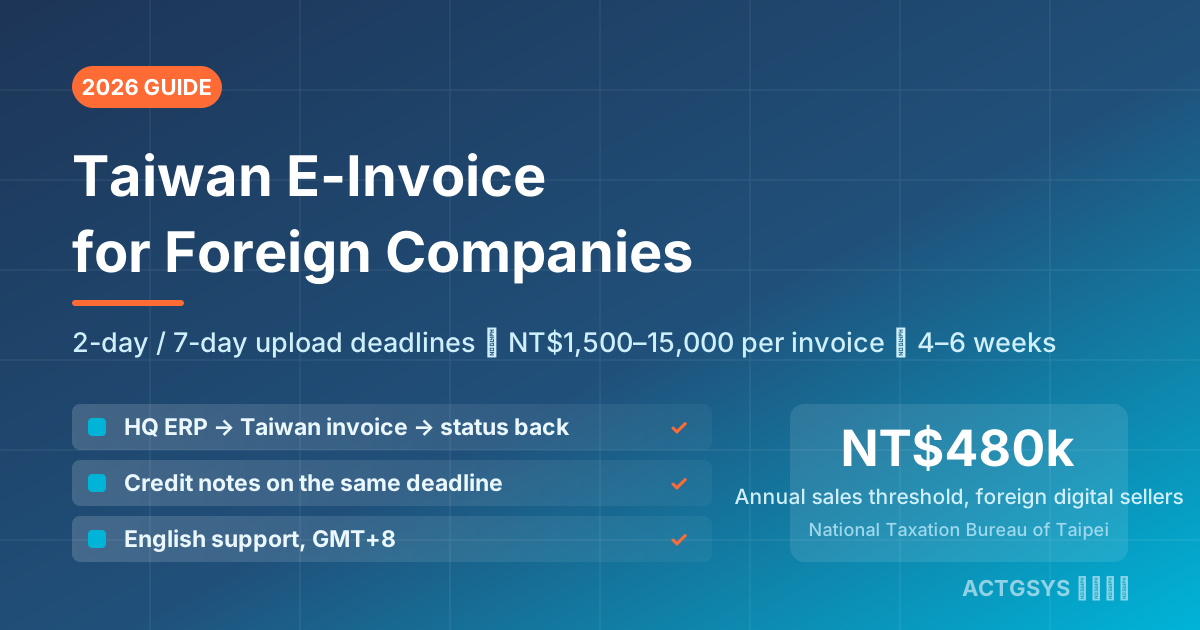
Taiwan E-Invoice for Foreign Companies 2026 - Cost
How a foreign-owned Taiwan subsidiary or branch connects its ERP to Taiwan's e-invoice platform: 2-day B2C / 7-day B2B upload deadlines, NT$1,500–15,000 per-invoice penalties, three integration paths, and a 4–6 week project from NT$50,000.
Anthropic Agent Skills as an Open Standard + Enterprise-Managed MCP Auth (2026): Wiring Claude into Stripe, Zapier, and Figma
In June 2026 Anthropic turned Agent Skills into an open standard, launching with 10 partners (including Atlassian, Figma, Canva, Stripe, Zapier), and on June 18 shipped Enterprise-Managed Authorization (EMA) for MCP connectors so IT admins can provision connectors org-wide via Okta. Here's what it means for 'wiring AI into your existing tools' and how Taiwan SMEs should adopt it.
US AI Export Controls Tighten and Anthropic Briefly Pulls Fable 5 (2026): Taiwan SMEs Suddenly Lose Top-Tier Models
In June 2026 the US escalated AI model export controls: a June 2 executive order, 'Promoting Advanced Artificial Intelligence Innovation and Security,' was followed mid-month by an order requiring Anthropic to block Mythos 5 and Fable 5 for non-US nationals — briefly disabling both for all customers. Taiwan SMEs are 'non-US nationals' and were directly affected. Here's the event, the risk, and a multi-model fallback strategy.
What would this cost you?
Answer five questions. Within three working days you get a price range and what it covers. No deck, no follow-up sales calls.
Prefer to talk?LINE·02-2553-8084