Anthropic Claude for Small Business (2026)
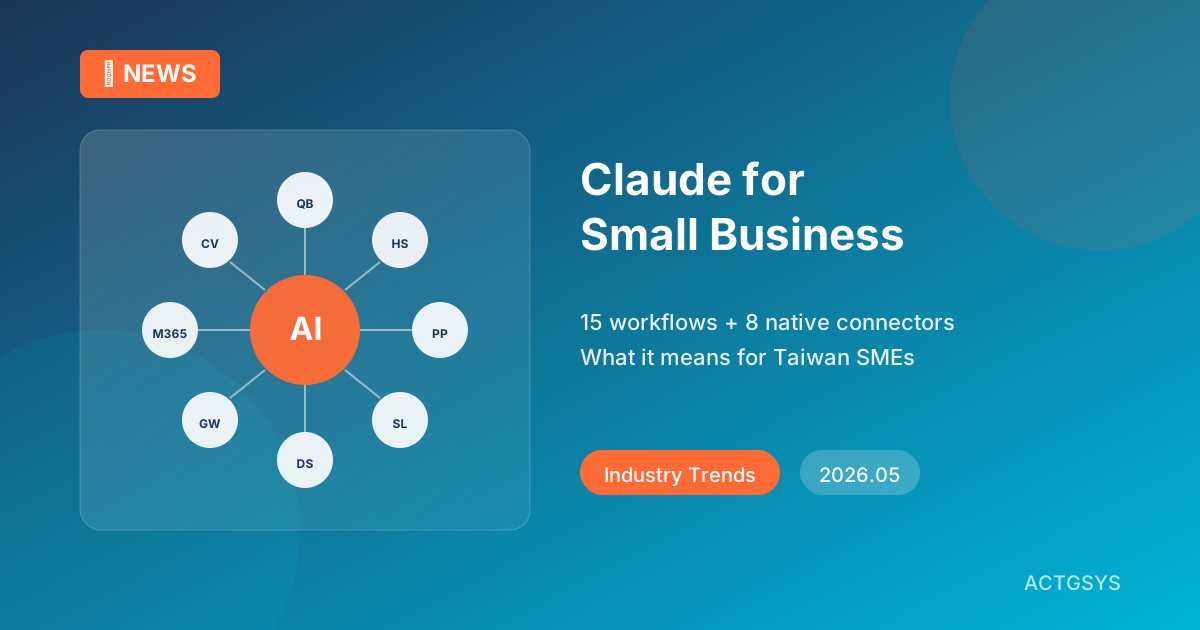
On May 13, 2026, Anthropic launched Claude for Small Business — a bundle of 15 ready-to-run agentic workflows and native connectors to eight common business tools, layered on top of Claude Team and Enterprise plans at no extra charge. For Taiwan SMEs, this is the moment AI shifts from "assemble your own stack" to "open the box and use it" — but the connector roster skews heavily US-centric, so the real question isn't whether to use it, but how it fits with your existing systems.
What Did Anthropic Announce with Claude for Small Business?
On May 13, 2026, Anthropic officially launched Claude for Small Business, a workflow and connector package targeted at small and mid-sized companies. According to Anthropic's official announcement (2026), this is not a new product tier — it sits on top of existing Claude Team or Enterprise subscriptions and bundles together ready-to-run agentic workflows, reusable skills, and connectors to common business SaaS.
The key fact is pricing: beyond an existing Claude license, Claude for Small Business is free of additional charge, and connector access is included. SMBs already on Claude Team effectively pick up the new capabilities at no incremental cost.
The significance isn't that the underlying Claude model got stronger — it's that Claude became usable without an engineer. Integrations, workflows, and prompt templates that previously had to be custom-built are now off-the-shelf options.
What's Included in Claude for Small Business?
Based on Anthropic's official launch page and Axios's coverage (2026), the headline items are:
- 15 ready-to-run agentic workflows — covering payroll planning, month-end close, invoice chasing, lead triage, contract review, campaign creation, cash-flow monitoring, and business pulse reporting. These are the tasks SMBs consistently hate doing manually.
- 15 reusable skills — letting users apply the same logic across their own scenarios without rewriting prompts each time.
- Eight native business connectors — QuickBooks, PayPal, HubSpot, Canva, Docusign, Google Workspace, Microsoft 365, and Slack.
- User-initiated tasks with human approval for sensitive actions — Claude won't auto-pay, auto-send, or auto-post; every outbound action requires a human confirmation.
- 10-city US training tour — starting May 14, Anthropic is running free half-day AI Fluency workshops for 100 SMB owners per stop, across Chicago, Tulsa, Dallas, New Jersey, Baton Rouge, Birmingham, Salt Lake City, Baltimore, San Jose, and Indianapolis.
Taken together, this is the first time Anthropic has treated SMBs as a distinct customer segment rather than expecting them to figure Claude out on their own.
How Does Claude for Small Business Compare to Plain Claude and Microsoft Copilot?
The biggest gaps are in "out-of-the-box readiness" and "integration breadth." A side-by-side:
| Aspect | Standard Claude Team | Claude for Small Business | Microsoft Copilot for SMB |
|---|---|---|---|
| Extra cost | None | None (requires Claude license) | Requires separate Copilot license |
| Ready-made workflows | None — DIY | 15 ready-to-run workflows | ~30+ Copilot Studio templates |
| External tool connectors | Self-built via MCP | 8 native integrations | Deep Microsoft 365 lock-in |
| Best for | Chat, writing, research | Cross-tool SMB processes | M365-centric office workflows |
| Security controls | Standard | Human approval for sensitive actions | Enterprise identity + DLP |
| Fit for Taiwan SMEs | High (general purpose) | Medium (US-centric connectors) | Medium-high (if already on M365) |
For SMEs, the read-through is straightforward: if your back office already runs on QuickBooks, HubSpot, and PayPal, this bundle is essentially plug-and-play. If you're on a Taiwan-local accounting system, a custom CRM, or a self-built ERP, the value collapses from "ready-made workflows" back to "slightly faster Claude."
How Did Developers and SMB Owners React?
Early developer reaction has been broadly positive, while sharply identifying the gap between "real SMBs" and "the SMBs Anthropic seems to have in mind."
The praise lands in three places: first, packaging integrations as native connectors instead of asking customers to write their own MCP servers dramatically lowers the barrier for non-technical business owners. Second, the 15 workflows are well-chosen — month-end close and invoice chasing in particular target work that no one wants to do but everyone has to. Third, the all-included pricing is refreshingly direct, with no surprise add-ons.
The criticism is also grounded. Many commenters noted that the SMBs who can actually use this still need to be paying for Claude Team plus QuickBooks plus HubSpot — a stack that's out of reach for micro-businesses running on spreadsheets and group chats. And the 10-city training tour is US-only, providing zero direct benefit to overseas SMBs.
In broader context, the direction makes sense. According to McKinsey's State of AI survey, over 70% of organizations already use AI in at least one business function (McKinsey, 2025) — meaning the next competitive frontier isn't "can we use AI" but "can we wire AI into the work we already do." Claude for Small Business commoditizes that integration layer, so SMBs don't need an engineering team to achieve it.
What Does This Mean for Taiwan SMEs?
For Taiwan SMEs, the signal matters more than the immediate feature set.
The signal: a top-tier AI provider has formally entered the SMB segment, which means the era of "AI is for big companies" is ending. Within the next year, similar packaged-workflow bundles will appear from OpenAI, Google, and Microsoft, giving SMEs an increasingly rich menu of options.
But the practical adoption decision hinges on two things:
- Connector coverage — HubSpot, QuickBooks, and PayPal have limited penetration in Taiwan. Most Taiwan SMEs use local accounting systems, local inventory tools, and LINE-based customer service — none of which are in Claude's native connector list. Applying the "invoice chasing" workflow may quickly reveal that Claude can't actually reach your AR data.
- Data boundaries — Claude for Small Business requires human approval for sensitive actions, which is good. But all data still flows through Anthropic's cloud. Customer lists, payroll, and cash flow are core business data; whether to push them entirely to an external cloud is a decision that needs an explicit owner.
This is the fundamental split between "ready-made SMB packages" and "custom AI integrated with your systems." The former is fast, cheap, and locks you into the vendor's ecosystem and US tooling. The latter takes design effort but lets AI safely read and write to your existing DanLee CRM customer data, Dinkoko ERP orders and inventory, or local accounting system — without moving core data outside. What ACTGSYS helps Taiwan SMEs build is the middle path: combining off-the-shelf AI capabilities with localized integration.
ACTGSYS Recommendations: What Should You Do Now?
Claude for Small Business is worth knowing about, but doesn't demand immediate action. Splitting "do now" from "watch and wait":
Do now:
- Audit your existing SaaS stack — list every accounting, CRM, document, and payment tool the business uses; mark which appear in Claude's connector list (HubSpot, QuickBooks, Google Workspace, Microsoft 365, etc.). High coverage means it's worth piloting.
- Trial 1–2 ready-made workflows — if you already pay for Claude Team, start with low-risk, high-value workflows like contract review or month-end close, and quantify the hours saved.
- Define data boundaries explicitly — the principal needs to personally decide what data goes into Claude (general docs, marketing copy) versus what doesn't (customer lists, payroll, contract source). Write it down as an internal policy.
- Track localization progress — if seriously considering adoption, watch whether Anthropic adds connectors for Taiwan-common tools (local accounting platforms, LINE Official Account APIs).
Watch and wait:
- Don't abandon custom AI plans — if you've already been scoping a custom AI integration (connecting DanLee, Dinkoko, or your local ERP), keep going. Claude for Small Business solves "US-centric SaaS integration" — it doesn't solve your local-system or data-governance challenge. The two are not mutually exclusive.
FAQ
Can Claude for Small Business Be Used in Taiwan?
Yes. Claude Team and Enterprise plans are available in Taiwan, and the workflows and connectors come with the plan. However, the 10-city training tour is US-only — Taiwan users will need to learn from official documentation on their own.
Does Claude for Small Business Cost Extra?
No additional charge — but you do need an existing Claude Team or Enterprise subscription, plus subscriptions to whatever SaaS tools you want to connect (QuickBooks, HubSpot, etc.). It is not available on Claude Pro or free tiers.
Should Taiwan SMEs Replace Custom AI Plans With Claude for Small Business?
Not necessarily. If your main tools are HubSpot, QuickBooks, Google Workspace, and Microsoft 365, it's worth trying. If your core data sits in a Taiwan-local accounting system, a custom CRM, or LINE-based customer service, those tools are outside the native connectors and the bundle's reach is limited — you still need a localized integration approach.
Will Claude for Small Business Automatically Send Emails or Make Payments?
No. Anthropic explicitly requires user confirmation for all outbound actions (emails, payments, posts). Claude does not trigger sensitive operations on its own, which is a design choice worth applauding.
Closing Thoughts
Claude for Small Business pushes "AI for SMBs" from "hire an engineer to customize" to "open the box and start." For Taiwan SMEs, the biggest value isn't how much this specific bundle solves today — it's the direction it reveals: top-tier AI will increasingly look like SaaS, and real differentiation will shift back to how safely your core data is exposed to it.
Looking to design an AI adoption path that combines off-the-shelf AI capabilities, local-system integration, and clear data governance? Contact ACTGSYS — we help Taiwan SMEs find the right balance between open AI tools and proprietary systems, with efficiency and security weighing equally.
Event date: May 13, 2026 (Claude for Small Business officially launched). Last updated: May 25, 2026.
Products & Solutions in This Article
AI-powered CRM for lead management, customer tracking, and sales pipeline optimization designed for SMEs.
AI-driven ERP focusing on procurement, inventory, and supply chain management. Each customer deployed on dedicated cloud infrastructure.
Intuitive accounting system designed for Taiwan SMEs, with automated bookkeeping and financial reporting.
Related Articles
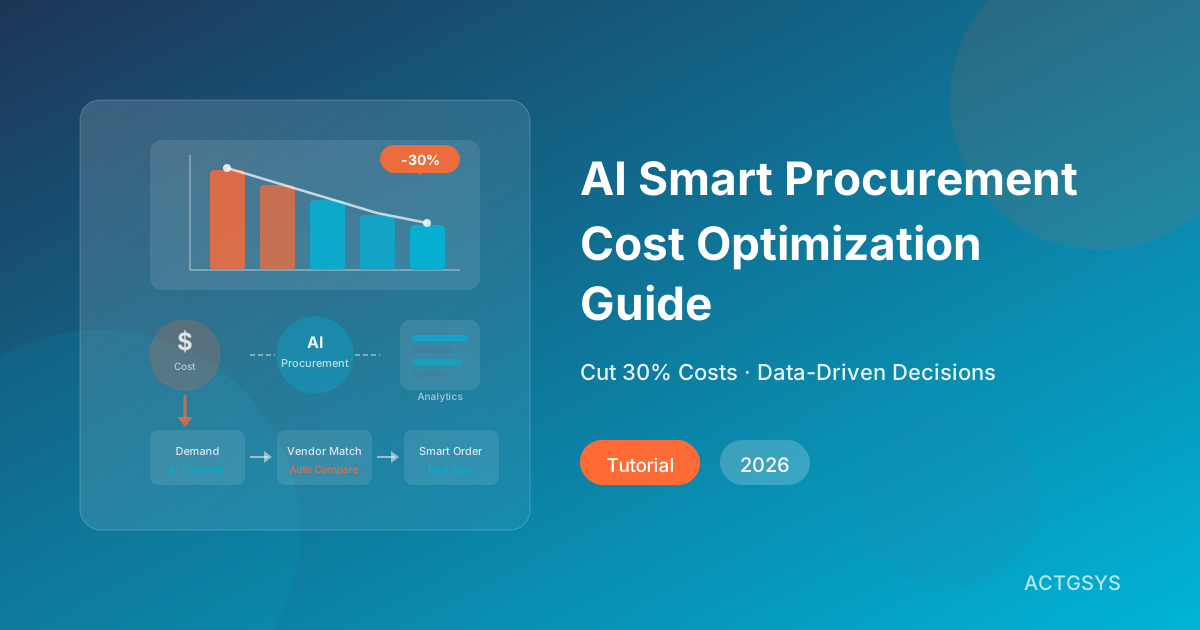
AI Smart Procurement & Cost Optimization Guide
Learn how AI is transforming procurement for small and mid-sized businesses — from supplier evaluation to price prediction, with ROI models, implementation steps, and Dinkoko ERP integration.
US AI Export Controls Tighten and Anthropic Briefly Pulls Fable 5 (2026): Taiwan SMEs Suddenly Lose Top-Tier Models
In June 2026 the US escalated AI model export controls: a June 2 executive order, 'Promoting Advanced Artificial Intelligence Innovation and Security,' was followed mid-month by an order requiring Anthropic to block Mythos 5 and Fable 5 for non-US nationals — briefly disabling both for all customers. Taiwan SMEs are 'non-US nationals' and were directly affected. Here's the event, the risk, and a multi-model fallback strategy.
Anthropic Claude Fable 5 (2026): Its Most Powerful Public Model Yet
On June 9, 2026, Anthropic launched Claude Fable 5 — its first Mythos-class model available to the general public, claimed to be state-of-the-art on nearly all tested benchmarks, alongside the restricted Claude Mythos 5. From June 23, pricing is $10 per 1M input tokens and $50 per 1M output. This article explains where this flagship belongs — and where it doesn't.
What would this cost you?
Answer five questions. Within three working days you get a price range and what it covers. No deck, no follow-up sales calls.
Prefer to talk?LINE·02-2553-8084