Coralogix Raises $200M at a $1.6B Valuation (2026)
Monitoring startup Coralogix announced a $200M Series F round on June 3, 2026, reaching a $1.6B post-money valuation, led by Advent and the Canada Pension Plan Investment Board (CPPIB) — a bet that as enterprises deploy AI agents en masse, someone needs to watch whether they're doing the right thing. For SMEs, the headline isn't another big raise — it's the signal: once AI agents start doing your work, "how you monitor them" matters as much as "how you build them."
What Happened with Coralogix?
Coralogix announced a $200M Series F round on June 3, 2026, reaching a $1.6B post-money valuation, led by private-equity firm Advent and the Canada Pension Plan Investment Board (CPPIB). According to TechCrunch (2026), the Boston-headquartered software-monitoring company is racing to build "the monitoring layer for AI agents."
The logic is blunt: enterprises used to monitor "applications" and "servers"; now they must monitor "AI agents" that decide and act on their own. As agents start auto-replying to customers, editing orders, and running flows, the business must know in real time: what did it do? Did it get it right? Where did it go wrong? Investors granting a $1.6B valuation are betting that "the more agents enterprises deploy, the greater the demand to monitor them."
Why Did 'AI Agent Observability' Suddenly Matter?
AI agent observability became a hot category because "AI that acts on its own" brings new risks traditional monitoring can't catch.
- Agents make their own decisions — traditional programs run fixed logic, so errors are reproducible; an AI agent's reasoning path can differ each time, so you must record "why it did what it did."
- Errors spill directly to customers — if an agent quotes the wrong price, edits the wrong order, or sends the wrong message, the harm is immediate and external — you can't discover it after the fact.
- Audit and compliance need a trail — finance, healthcare, and similar industries must be able to explain "how the AI made this decision"; without logs, there's no accountability.
- Costs can quietly spiral — agents make multi-step model calls, so token usage and API costs can surge, requiring real-time monitoring.
How Is an 'Unwatched Agent' Different From an 'Observable Agent'?
Many SMEs deploying AI automation only think about "getting it running" and overlook "being able to see what it's doing." The difference becomes painfully clear when something goes wrong:
| Comparison | Unwatched agent (no monitoring) | Observable agent |
|---|---|---|
| On error | Found only via customer complaint | Real-time alerts, traceable |
| Decision trail | Black box, unrecorded | Records every reasoning step and action |
| Cost control | Realized when the bill arrives | Real-time token & API usage monitoring |
| Guardrails | None — agent can run wild | Limits and no-go zones; over-limit is blocked |
| Audit/compliance | Cannot account for it | Full logs as evidence |
| Basis for improvement | Gut feeling | Continuous optimization on real data |
(Conceptual summary; market trend per TechCrunch (2026).)
The key takeaway: observability isn't a "do it later when there's time" bonus — it's the prerequisite for daring to put agents live. Not seeing what an agent is doing means handing your customer relationships and your bills to a black box you can't monitor.
What Do Developers and the Industry Think?
The industry broadly sees "agent monitoring" as the next battleground after "agent building."
The positive read centers on a necessary catch-up — while 2025–2026 was spent "building agents out," the focus in late 2026 is shifting to "how to run agents safely and controllably over the long term." Heavy capital flowing into the monitoring layer is seen as a sign of market maturity: agents are graduating from toys to accountable production systems.
The reservations center on tools not replacing design — some warn that buying a monitoring tool isn't governance. If you didn't design the agent's permission boundaries and guardrails up front, even the best monitoring just lets you "watch it fail more clearly."
In the bigger frame, this echoes Gartner's warning that over 40% of agentic AI projects will be canceled by the end of 2027, due to escalating costs, unclear business value, and inadequate risk controls (Gartner, 2025). In other words, agent projects without observability and governance are themselves a high-failure-risk group.
What Does This Mean for SMEs?
For SMEs, the real lesson of Coralogix's raise is: before you let AI agents reply to customers, edit orders, and run flows for you, figure out "how to monitor them." You don't need an expensive enterprise monitoring platform, but "observability" must be built into every AI automation project.
Opportunities and necessary prep:
- Set guardrails before releasing agents — clearly define what the agent "can and can't do" (e.g., can look up orders, but price changes need human approval), and make high-risk actions require human confirmation.
- Keep full operation logs — record every step of "what data the agent saw, what decision it made, what action it executed," so you can trace errors and optimize routinely.
- Monitor cost in real time — watch token and API usage, set budget caps and alerts, and avoid bill surprises.
- Set alerts and human-handoff mechanisms — when an agent hits an uncertain situation, it should auto-escalate to a human rather than bluff an answer.
Things to be realistic about:
- You don't need a heavy monitoring platform from day one — SMEs can start with the basics of "logs + guardrails + budget alerts" and consider professional tools as scale grows.
- Monitoring is a design problem, not just a tool problem — design the agent's permission boundaries first, or monitoring is meaningless.
- Budget for observability — don't only estimate the cost of "building the agent"; include "monitoring and governance" too.
In practice: for AI support in DanLee CRM and order automation in Dinkoko ERP, we build in "operation logs + permission guardrails + human approval for high-risk actions + cost alerts" right into the agent workflow design — so you enjoy automation efficiency while always being able to see and control what the agent is doing.
ACTGSYS Recommendation: What Should You Do Now?
Coralogix's raise is a "mindset reminder" for SMEs: observability is required equipment for AI automation, not an optional extra.
Do now:
- List a "no-go" list for each AI agent — clearly write down actions the agent must never take on its own (price changes, refunds, deleting data), and make them all require human approval.
- Require operation logs in every AI project — when deploying any AI automation, make "full logging of every agent step" a baseline requirement, not an afterthought.
- Set cost and usage alerts — set budget caps and real-time alerts for AI agents to keep token/API costs from quietly spiraling.
Hold off:
- Don't rush to buy a heavy monitoring platform — start with the basics of logs, guardrails, and alerts; assess professional observability tools once agent count and risk grow.
- Don't avoid agents entirely out of fear — the right approach is using them "with guardrails set + visibility," not abandoning the tool over the risk.
Frequently Asked Questions
What is AI agent observability?
It's the ability to see and record, in real time, "what data the AI agent looked at, why it decided as it did, what action it executed, and how much it cost." It lets you alert and trace when an agent errs, and optimize on real data routinely — the prerequisite for safely putting agents live.
Do SMEs have to buy a monitoring tool to deploy AI agents?
Not necessarily an expensive enterprise platform. SMEs can start with the basics of "full operation logs + permission guardrails + human approval for high-risk actions + cost alerts" — low cost and covering most risks. Assess professional observability tools once agent count and business scale grow.
Why is so much money going into "monitoring AI agents"?
Because after enterprises finished "building agents," the next question is running them safely, controllably, and auditably over the long term. Since agents auto-reply to customers and edit orders, the cost of errors is immediate and external, making the monitoring layer a must-have — so capital is betting heavily on this new market.
My company doesn't use AI agents yet — should I care now?
Yes. Observability is best planned "before deploying your first agent," not patched after something breaks. Even before deploying, establish the mindset that "agents must have guardrails, logs, and cost alerts before going live," and you'll avoid many detours later.
Conclusion
Coralogix raising $200M at a $1.6B valuation is a clear market signal: in the age of AI agents, "how you monitor them" matters as much as "how you build them." For SMEs, the right response isn't to be daunted by the number — it's to make "observability" standard equipment for every AI automation project: set guardrails, keep logs, set cost alerts, and let agents work for you under conditions you can see and control.
Want to deploy AI automation while being able to "see and control what agents are doing from day one"? Contact ACTGSYS — we help Taiwanese SMEs design AI agent workflows with built-in guardrails, logs, and cost alerts, so automation is both efficient and safely under control.
Event date: June 3, 2026 (Coralogix announces $200M raise). Last updated: June 9, 2026.
Products & Solutions in This Article
AI-powered CRM for lead management, customer tracking, and sales pipeline optimization designed for SMEs.
AI-driven ERP focusing on procurement, inventory, and supply chain management. Each customer deployed on dedicated cloud infrastructure.
Related Articles
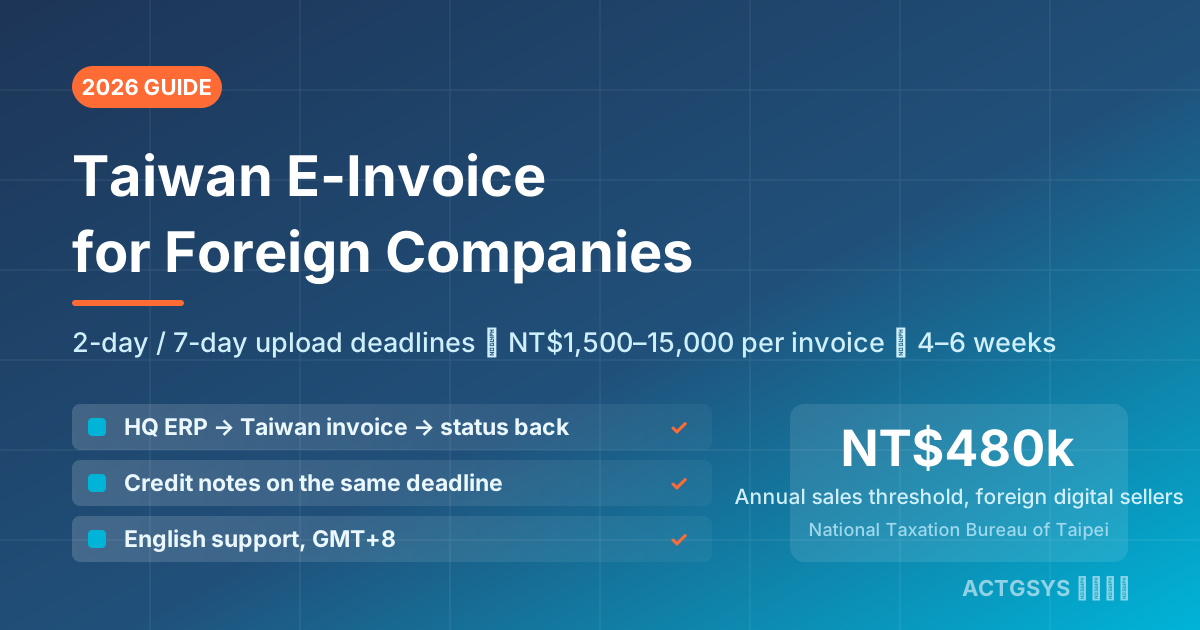
Taiwan E-Invoice for Foreign Companies 2026 - Cost
How a foreign-owned Taiwan subsidiary or branch connects its ERP to Taiwan's e-invoice platform: 2-day B2C / 7-day B2B upload deadlines, NT$1,500–15,000 per-invoice penalties, three integration paths, and a 4–6 week project from NT$50,000.
Microsoft Agent 365 Goes Live (2026): AI Agent Governance Becomes the New Battleground for SMEs
Microsoft launched Agent 365 on May 1, 2026 — a $15-per-user-per-month control plane for governing enterprise AI agents. Here is what it solves, how it differs from DIY management, and what Taiwan SMEs should do.
Anthropic Agent Skills as an Open Standard + Enterprise-Managed MCP Auth (2026): Wiring Claude into Stripe, Zapier, and Figma
In June 2026 Anthropic turned Agent Skills into an open standard, launching with 10 partners (including Atlassian, Figma, Canva, Stripe, Zapier), and on June 18 shipped Enterprise-Managed Authorization (EMA) for MCP connectors so IT admins can provision connectors org-wide via Okta. Here's what it means for 'wiring AI into your existing tools' and how Taiwan SMEs should adopt it.
What would this cost you?
Answer five questions. Within three working days you get a price range and what it covers. No deck, no follow-up sales calls.
Prefer to talk?LINE·02-2553-8084