DeepSeek V4-Pro Cuts Prices 75% Permanently (2026)
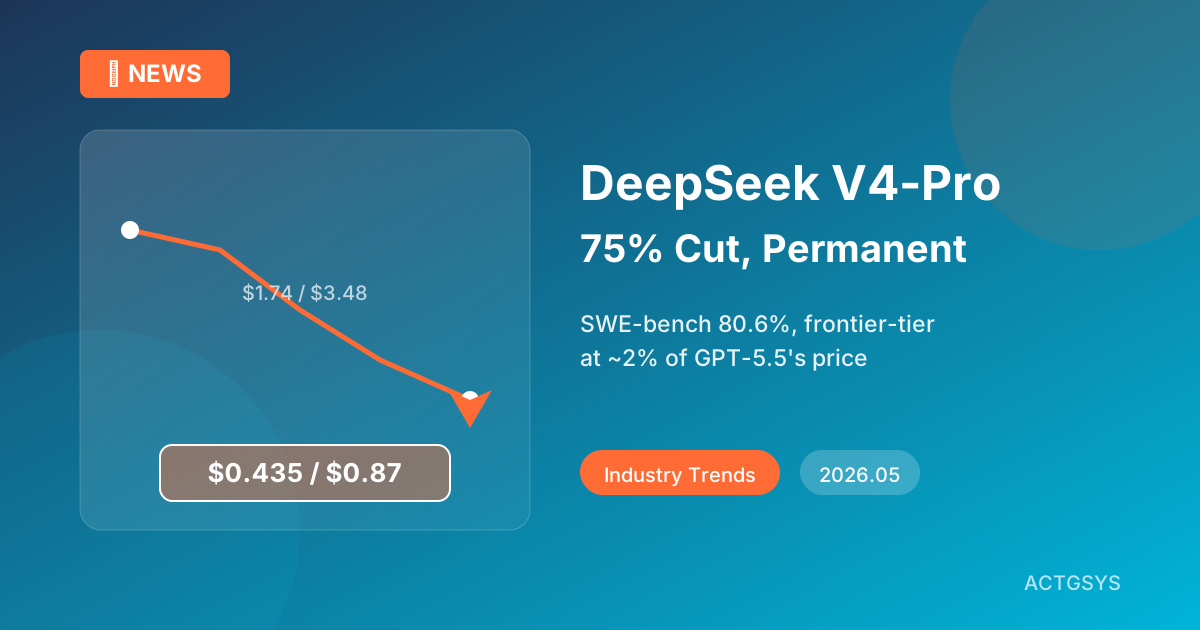
On May 23, 2026, DeepSeek announced it is making the V4-Pro 75% discount — originally set to expire May 31 — permanent: $0.435 per 1M input tokens and $0.87 output, putting frontier-tier capability at roughly 2% of GPT-5.5's price. For Taiwan SMEs, this isn't just "another cheap Chinese model" — the AI API price war has officially entered a "frontier capability = bargain-bin pricing" phase, and the AI use cases that were previously blocked by cost may now pencil out entirely differently.
What Happened With DeepSeek V4-Pro?
On May 23, 2026, DeepSeek announced it is converting the V4-Pro 75% promotional discount into permanent standard pricing. According to DeepSeek's official API pricing docs (2026), the discount was originally set to expire at 15:59 UTC on May 31, 2026 — it is now the long-term rate.
The timeline is worth clarifying: V4-Pro first launched on April 24, 2026 at $1.74 per 1M input tokens and $3.48 output. Within days, DeepSeek introduced a 75% discount, cutting prices to $0.435 input and $0.87 output. Now that promotional price is permanent. The permanent structure: $0.435 per 1M input tokens, $0.87 output, and $0.003625 per 1M cache-hit input tokens (Engadget, 2026).
Why does this cut matter so much? Because it's not "a cheap small model getting cheaper" — it's "a frontier-tier model dropping to a fraction of the going rate." When DeepSeek first launched Pro, it warned the Pro tier could cost up to 12x the lighter Flash version due to constraints in high-end compute, hinting prices would ease once Huawei Ascend 950 supernodes arrived in bulk in the back half of the year. Making the cut permanent early signals compute supply genuinely improved — and pulls the industry's price floor down another notch.
How Capable Is DeepSeek V4-Pro?
DeepSeek V4-Pro doesn't win on price alone — its benchmark numbers sit in the top tier. According to third-party evaluations:
- SWE-bench Verified: 80.6% — real software-engineering task solve rate, just 0.2 points behind Claude Opus 4.7's 80.8% and clearly ahead of GPT-5.5's 74.9% (Codersera, 2026).
- LiveCodeBench: 93.5% — real-time coding capability test.
- Codeforces rating: 3206 — competition-grade coding, top tier.
- Architecture: 1.6T parameters, open source — weights are public; you can self-host or use via API.
In other words, V4-Pro nearly matches Claude Opus 4.7 (one of the best-regarded coding models) on coding and software-engineering tasks, but at a fraction of the price. That's the most striking part of this event: the traditional relationship between capability and price has been broken.
How Does DeepSeek V4-Pro Compare to GPT-5.5, Claude, and Gemini? (Price vs. Capability)
The most-searched query for any tech-news piece is "DeepSeek vs GPT-5.5." The table lays out price and coding capability across four leading models:
| Model | Input ($/1M) | Output ($/1M) | SWE-bench Verified | Open source |
|---|---|---|---|---|
| DeepSeek V4-Pro | 0.435 | 0.87 | 80.6% | Yes |
| Claude Opus 4.7 | 5.00 | 25.00 | 80.8% | No |
| GPT-5.5 | Higher | Higher | 74.9% | No |
| Gemini 3.5 Flash | 1.50 | 9.00 | — | No |
(Prices per each vendor's official announcement; by DeepSeek's own comparison, GPT-5.5 Pro costs roughly 98% more per token.)
The key read: on coding / software-engineering tasks, DeepSeek V4-Pro hits nearly the same SWE-bench score as Claude Opus 4.7 at about 1/11 the input price and 1/29 the output price. For cost-sensitive workloads with heavy code or automation-generation needs, that gap is too large to ignore. But note — strong benchmarks don't mean strong on every task. Chinese-language customer service, domain-specific knowledge, and compliance still need testing on your own real tasks.
What Do Developers and the Industry Think?
Community reaction centered on two tensions: "stunning price-performance" and "should you use a Chinese model."
The praise focuses on price-performance — developers broadly confirm V4-Pro performs within a hair of top closed models on coding and agent tasks, at a fraction of the cost. For solo developers and budget-limited teams, that flattens the bar to "affording frontier models." Making the cut permanent also removes the "it'll snap back when the promo ends" uncertainty, making people comfortable putting it into production.
The reservations focus on data governance and provenance — some enterprise users are wary of "sending data to a China-based vendor's cloud," especially for workloads touching customer PII or financial data. The good news: V4-Pro is open source, so you can self-host on your own or a neutral cloud to avoid cross-border data issues — though self-hosting requires compute and ops capability.
Zooming out, this cut echoes Gartner's long-running observation: enterprise AI investment is shifting from "competing on model strength" to "competing on unit task cost" (Gartner, 2025). When frontier capability gets priced to the floor, the axis of competition shifts from "who's strongest" to "who can do the same job at lower cost, more controllably."
What Does This Mean for Taiwan SMEs?
For Taiwan SMEs, the DeepSeek V4-Pro permanent cut is a "re-do the AI math" signal — not a "blindly migrate" command.
The opportunity:
- Per-task AI cost may drop sharply — workloads previously blocked by API cost (bulk document summarization, code generation, batch data processing, customer-service auto-replies) may now pencil out with V4-Pro.
- Coding / automation generation benefits most — if your needs lean toward code, reports, or structured-data generation, V4-Pro's 80.6% SWE-bench plus bargain pricing is a compelling combination.
- Open source enables deployment flexibility — you can self-host to keep data on your own or a Taiwan/neutral cloud, balancing cost and data residency.
But watch three things:
- Data governance trumps price — for workloads touching customer PII, financials, or trade secrets, confirm data flows and compliance requirements before choosing API vs. self-host. Cheap can't override data security.
- Test on real tasks, not just benchmarks — a high SWE-bench doesn't mean your Chinese-language customer service or industry-specific Q&A is strong. Run an A/B on your most common real tasks first.
- Avoid single-vendor lock-in — in a price war, vendors take turns cutting prices. Keep model-switching flexibility in your system so you can move to whoever is cheapest-and-best on your tasks.
When wiring AI into DanLee CRM for customer Q&A, or into TanJee for document and data processing, keep a model-routing layer in your architecture — so every time someone cuts prices (like DeepSeek here), you can re-shop and switch fast instead of being locked to a single vendor's pricing.
ACTGSYS Recommendation: What Should You Do Now?
DeepSeek V4-Pro is worth serious evaluation, especially for SMEs with heavy coding and automation-generation needs. Here's the split:
Do now:
- Inventory current AI usage and cost structure — split the last three months of AI API bills into "coding / generation" and "customer service / conversation," and find which is large and most exposed to the price cut.
- Run an A/B test on coding / generation scenarios — if you have code generation, report automation, or batch summarization, run V4-Pro at low volume for 1-2 weeks and quantify "cost reduction vs. quality difference."
- Do a data-governance inventory first — list which workloads touch customer PII, financials, or confidential data; prioritize "self-hosting an open model" for these over sending data to an API.
- Build a model-switching abstraction layer — add model routing so coding tasks go to V4-Pro and sensitive customer service goes to self-hosted or other vendors, optimizing cost and compliance by task type.
Hold for now:
- Don't rush to move sensitive-data workloads — if your core application involves heavy customer PII and the compliance path isn't clear yet, keep your current setup and re-evaluate once the data-governance architecture is settled.
Frequently Asked Questions
Can DeepSeek V4-Pro be used in Taiwan?
Yes. You can use it via DeepSeek's official API, or — because it's open source — self-host it on your own servers, a Taiwan, or a neutral cloud. For workloads touching customer PII or financial data, self-hosting is recommended to control data residency and compliance rather than sending data directly to a third-party cloud.
After the permanent cut, is DeepSeek V4-Pro cheaper than GPT-5.5 or Claude?
For coding and software-engineering tasks, very much so — SWE-bench 80.6% nearly matches Claude Opus 4.7 (80.8%) at a fraction of the price. But "cheaper" depends on the task: Chinese-language customer service, domain Q&A, and compliance-sensitive apps still need testing on your real tasks, with data-governance cost factored into the total.
Is the DeepSeek V4-Pro price cut promotional or permanent?
Permanent. On May 23, 2026, DeepSeek announced it is converting the 75% discount — originally set to expire May 31 — into permanent standard pricing: $0.435 per 1M input tokens and $0.87 output. That's the key difference from a limited-time promo — you can confidently factor it into long-term product cost planning.
Should SMEs move their AI workloads to DeepSeek V4-Pro right now?
Not necessarily all of them. We recommend a "split" approach: prioritize cost-sensitive, non-confidential coding/generation tasks for V4-Pro; do data governance first for workloads touching customer PII. The most pragmatic move is building model-switching capability and picking the best model per task type — not putting all eggs in one basket.
Conclusion
The real signal of DeepSeek V4-Pro's permanent cut isn't "another cheap model" — it's "frontier capability has officially entered the bargain-bin era." The traditional capability-price relationship is broken, and the axis of AI competition shifts to "who can do the same job at lower cost, more controllably." For Taiwan SMEs, the right response is "re-do the math, test on real tasks, put data governance before price, and keep switching flexibility."
Want an AI architecture that can flexibly switch between models, optimize cost by task type, and hold the line on data governance? Contact ACTGSYS. We help Taiwan SMEs capture the upside of this AI price war without sacrificing data security or vendor choice.
Event date: May 23, 2026 (DeepSeek makes the V4-Pro 75% discount permanent). Last updated: May 28, 2026.
Products & Solutions in This Article
AI-powered CRM for lead management, customer tracking, and sales pipeline optimization designed for SMEs.
Intuitive accounting system designed for Taiwan SMEs, with automated bookkeeping and financial reporting.
Related Articles
AI Cross-Border Ecommerce Playbook for SMEs (2026)
How Taiwan SMEs use AI to automate cross-border e-commerce — multilingual listings, smart customer service, dynamic pricing, ad ops, and logistics forecasting across Amazon, Shopify, Shopee, Lazada, and TikTok Shop.
Anthropic Agent Skills as an Open Standard + Enterprise-Managed MCP Auth (2026): Wiring Claude into Stripe, Zapier, and Figma
In June 2026 Anthropic turned Agent Skills into an open standard, launching with 10 partners (including Atlassian, Figma, Canva, Stripe, Zapier), and on June 18 shipped Enterprise-Managed Authorization (EMA) for MCP connectors so IT admins can provision connectors org-wide via Okta. Here's what it means for 'wiring AI into your existing tools' and how Taiwan SMEs should adopt it.
US AI Export Controls Tighten and Anthropic Briefly Pulls Fable 5 (2026): Taiwan SMEs Suddenly Lose Top-Tier Models
In June 2026 the US escalated AI model export controls: a June 2 executive order, 'Promoting Advanced Artificial Intelligence Innovation and Security,' was followed mid-month by an order requiring Anthropic to block Mythos 5 and Fable 5 for non-US nationals — briefly disabling both for all customers. Taiwan SMEs are 'non-US nationals' and were directly affected. Here's the event, the risk, and a multi-model fallback strategy.
What would this cost you?
Answer five questions. Within three working days you get a price range and what it covers. No deck, no follow-up sales calls.
Prefer to talk?LINE·02-2553-8084