Salesforce Summer '26 (2026): Agentforce Goes Multi-Agent
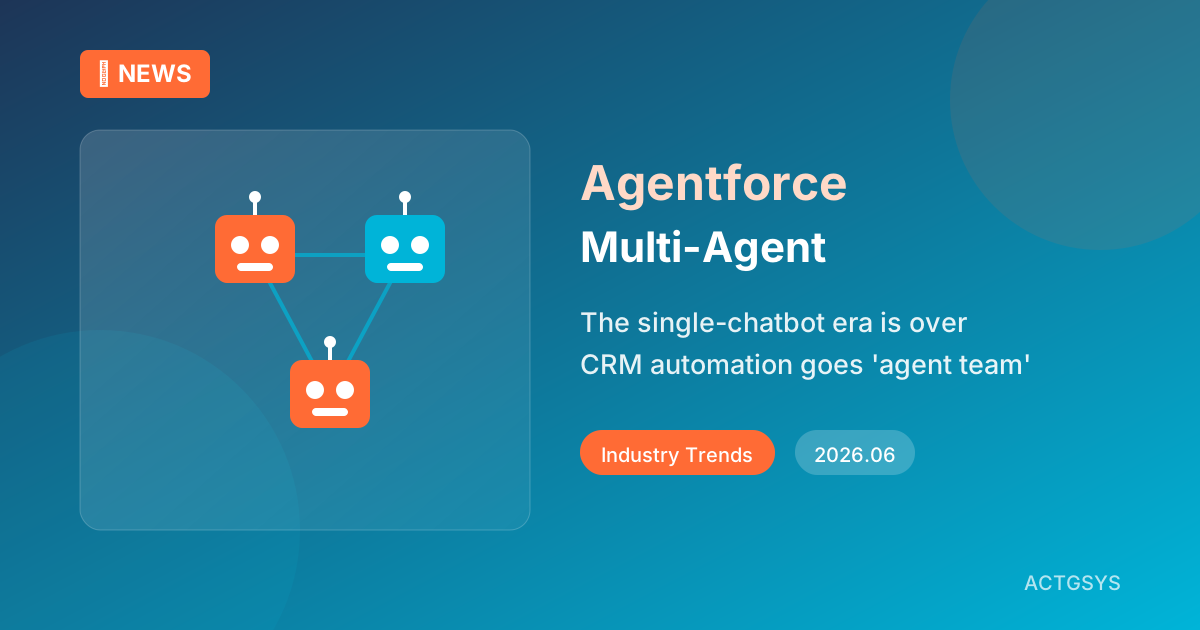
Salesforce announced its Summer '26 release in early June 2026 (rolling out from June 15), and the headline is Agentforce Multi-Agent Orchestration — letting multiple AI agents work like a team, sharing context and collaborating across channels to complete end-to-end workflows. For SMEs, the point isn't another Salesforce feature — it's the signal: CRM AI automation is officially moving from "a single chatbot" to "a team of agents that divide labor and hand off."
What Did Salesforce Announce in Summer '26?
Salesforce announced its Summer '26 product release in early June 2026, rolling out from June 15. According to Salesforce's official announcement (2026), the release pushes the "Agentic Enterprise" from experimentation to scaled impact, helping businesses move from "playing with AI" to "creating measurable results with AI."
The updates most relevant to SMEs:
- Agentforce Multi-Agent Orchestration — multiple AI agents working as a unified team, sharing context across all channels to solve complex, end-to-end workflows, rather than isolated single bots.
- Tableau MCP — a secure, open integration that lets AI agents query Tableau's analytics engine directly, delivering accurate answers grounded in business context, with data protected by the Agentforce Trust Layer.
- Slack-first workflows — bringing agent collaboration into the interface teams use daily.
- Real-time data activation and AI customer engagement — letting agents act on the latest data, not a stale snapshot.
What Are the Key Points of Multi-Agent Orchestration?
The core idea is splitting "one do-everything bot" into "multiple specialized agents that hand off to each other."
- Shared context — agents pass conversation and data context between them, so the customer doesn't re-explain at every step.
- Cross-channel collaboration — a single case can span website, email, Slack, and support, handed off between agents with consistent state.
- End-to-end workflows — the goal is completing an entire flow (inquiry → quote → order → after-sales), not just answering one question.
- Trust Layer protection — when querying data via integrations like Tableau MCP, permissions and security are governed by the Agentforce Trust Layer.
How Is Multi-Agent Different From a Single Chatbot?
Most SME CRM AI used to be "a single support chatbot." Multi-agent orchestration is a completely different architecture:
| Comparison | Traditional single chatbot | Agentforce Multi-Agent Orchestration |
|---|---|---|
| Scope | Answers single questions | Completes end-to-end workflows |
| Context | Single session, breaks at handoff | Shared across agents and channels |
| Division of labor | One bot does everything | Specialized agents hand off |
| Data access | Mostly canned answers | Real-time queries (e.g. Tableau MCP) |
| Governance | Weak | Unified permissions via Trust Layer |
| Best for | FAQ, simple support | Sales, orders, cross-team flows |
(Source: Salesforce official announcement (2026).)
The key takeaway: multi-agent orchestration isn't about "answering more accurately" — it's about "running an entire business process to completion." That's exactly where SMEs get stuck: a bot can answer questions but can't actually close the sale or follow after-sales through.
What Do Developers and the Industry Think?
The consensus is "multi-agent is the inevitable direction," but with a caution to SMEs not to be swept up by marketing.
The positive read centers on agents actually doing work — nearly every major enterprise software vendor has reached the same understanding: AI agents will shoulder far more operational work than they do today (from Salesforce's Agentforce and Microsoft's 365 Copilot to Workday's Illuminate and SAP's Joule). Summer '26's multi-agent orchestration and Tableau MCP are seen as turning "agent teams" from concept into a buyable product.
The reservations center on deployment difficulty and data quality — multi-agent orchestration only works if your CRM data is clean and your processes are well-defined. For companies with messy data and undefined processes, adding multi-agent only amplifies the chaos.
In the bigger frame, this echoes Gartner's prediction that by 2028, at least 15% of day-to-day work decisions will be made autonomously by agentic AI (up from ~0% in 2024) (Gartner, 2024). CRM is one of the front lines of this agentic shift because it sits directly on revenue.
What Does This Mean for SMEs?
For SMEs, Salesforce's multi-agent orchestration is a "direction confirmation": the future of CRM automation isn't "install a support bot" — it's "design a set of agent workflows that divide labor and hand off." But whether to buy Salesforce itself depends on your scale and budget.
Opportunities:
- Complex flows can finally be automated — what used to be limited to FAQ answers can now have cross-step flows (inquiry → quote → order → after-sales follow-up) handled by an agent team in relay.
- More reliable, data-driven answers — designs like Tableau MCP, which let agents "query live data directly," reduce bots giving wrong or stale answers.
- Consistent cross-channel experience — customers arriving via LINE, email, or web get caught by the same context, without re-explaining.
But stay realistic about three things:
- Salesforce may be too heavy for small firms — Agentforce's licensing and deployment costs are high for many Taiwanese SMEs. You don't have to buy Salesforce to benefit from the multi-agent concept.
- Data quality is a prerequisite — multi-agent amplifies data problems. Clean up customer data and process definitions before deploying, or you're just creating chaos more expensively.
- Start with one flow — don't try to automate everything at once. Pick one high-frequency, clearly-ruled flow (like quoting or after-sales follow-up) to try first.
In practice: you don't need Salesforce to apply the same "multi-agent orchestration" thinking. On DanLee CRM, we can design a "sales-inquiry agent + quoting agent + after-sales follow-up agent" division of labor, connected to order and inventory data in Dinkoko ERP so agents see live, accurate information — an SME-scale implementation of the Tableau MCP concept. The same agent workflow can be exposed via LINE, the channel your customers use most.
ACTGSYS Recommendation: What Should You Do Now?
Salesforce Summer '26 is a "strategic direction confirmation" for SMEs, not a "must buy Salesforce" event.
Do now:
- Inventory one end-to-end flow worth automating — pick a high-frequency, clearly-ruled, cross-step flow (like quoting or after-sales follow-up) as your first multi-agent pilot.
- Clean up CRM data quality — before deploying any agent, clean customer data and define products and processes. This is the key prerequisite for multi-agent success.
- Connect real-time data between CRM and ERP — let future agents see live orders, inventory, and customer status, not stale snapshots. This is the foundation of "answering accurately."
Hold off:
- Don't jump to Salesforce just for multi-agent — assess scale and budget first; most Taiwanese SMEs are better served by a lighter, customizable solution implementing the same concept.
- Don't automate every flow at once — get one flow running smoothly and measure results before expanding the scope of agent division of labor.
Frequently Asked Questions
Can I use Salesforce Agentforce multi-agent orchestration in Taiwan?
Yes. The Salesforce Summer '26 release rolls out from June 15, 2026, and Salesforce customers globally (including Taiwan) can use Agentforce Multi-Agent Orchestration per their license tier. Note Agentforce's licensing and deployment costs, and assess fit for your company's scale and budget first.
Do SMEs have to use Salesforce to do "multi-agent orchestration"?
No. Multi-agent orchestration is an architectural approach, not a Salesforce-only feature. SMEs can implement the same "agent division of labor + shared context + live data queries" on a lighter, customizable CRM (like DanLee CRM), usually at a more controllable cost.
What is Tableau MCP? Is it useful for SMEs?
Tableau MCP is an integration that lets AI agents query Tableau analytics data directly and securely via MCP (Model Context Protocol). For SMEs, the real lesson is that "letting AI agents access live, permission-protected business data" matters — you don't need Tableau, but live CRM/ERP data integration is key.
Is multi-agent orchestration worth deploying now?
It's worth trialing on one flow, but don't overreach. Pick a high-frequency, clearly-ruled flow as a pilot; clean your data, get one agent team running smoothly, measure results, then decide whether to scale. Deploying multi-agent on messy data only amplifies the chaos.
Conclusion
Salesforce Summer '26's multi-agent orchestration marks CRM automation moving from "a single chatbot" to "a team of agents that divide labor." For SMEs, the right response isn't to rush to buy Salesforce — it's to pick one end-to-end flow as a pilot, clean up CRM data, connect real-time data between CRM and ERP, and implement the same multi-agent concept in a more controllable way.
Want to design a CRM agent workflow that divides labor, hands off, and queries live data — connected to your existing order and inventory systems? Contact ACTGSYS — we help Taiwanese SMEs turn the latest agent-orchestration trends into deployable, cost-controlled automation.
Event date: early June 2026 (Salesforce announces Summer '26, GA from June 15). Last updated: June 9, 2026.
Products & Solutions in This Article
AI-powered CRM for lead management, customer tracking, and sales pipeline optimization designed for SMEs.
AI-driven ERP focusing on procurement, inventory, and supply chain management. Each customer deployed on dedicated cloud infrastructure.
Related Articles
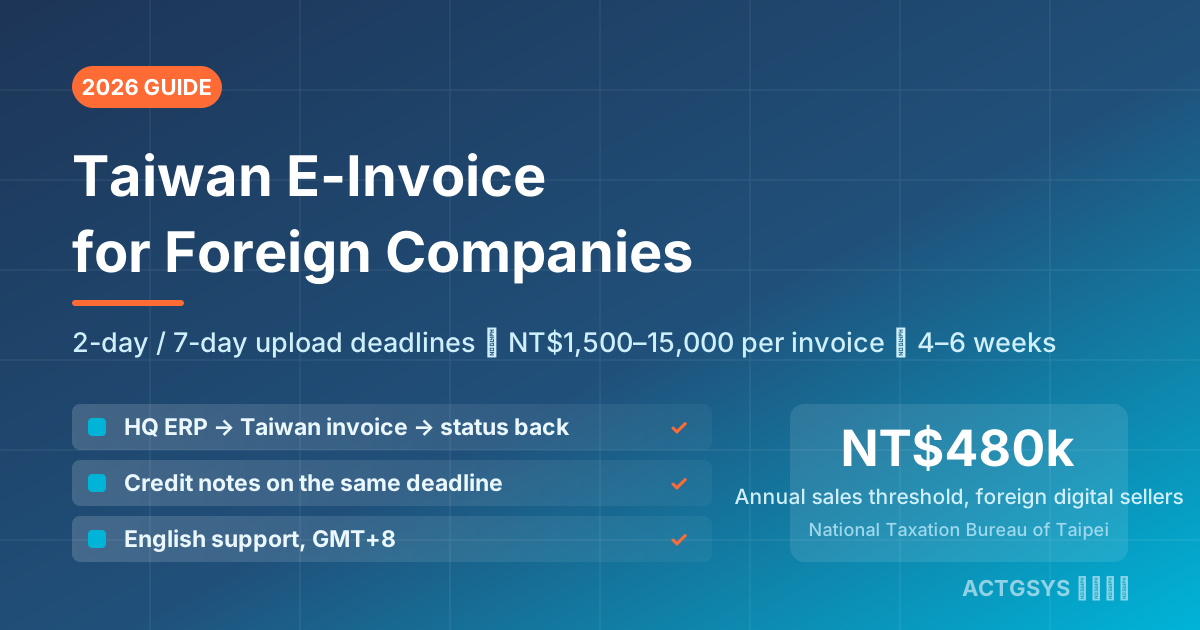
Taiwan E-Invoice for Foreign Companies 2026 - Cost
How a foreign-owned Taiwan subsidiary or branch connects its ERP to Taiwan's e-invoice platform: 2-day B2C / 7-day B2B upload deadlines, NT$1,500–15,000 per-invoice penalties, three integration paths, and a 4–6 week project from NT$50,000.
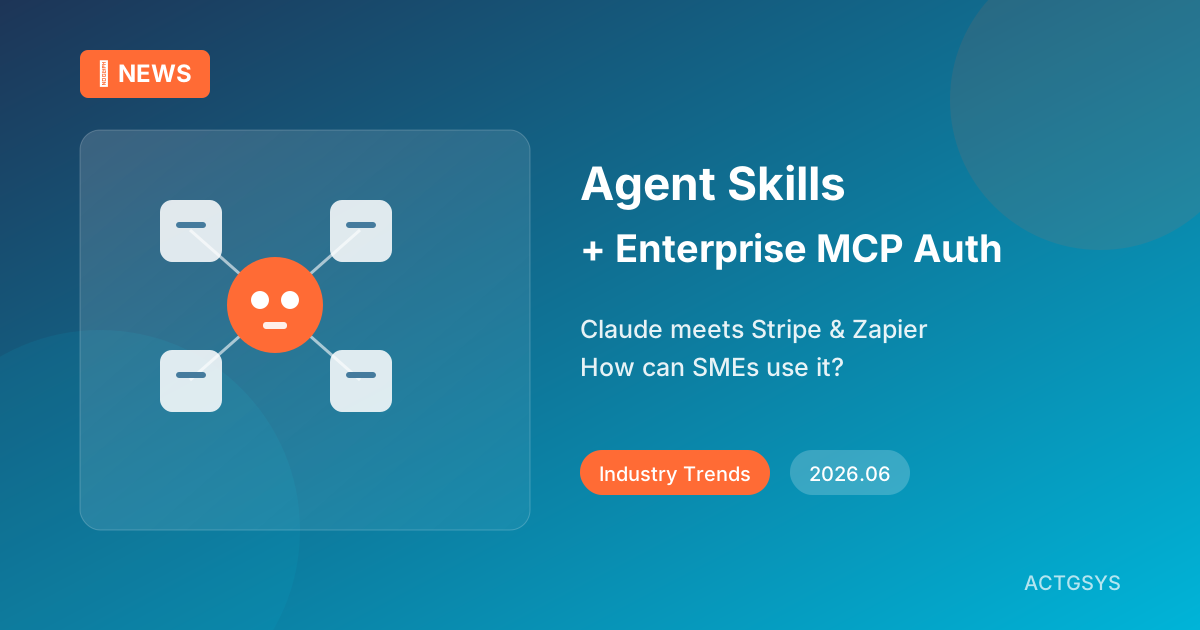
Anthropic Agent Skills as an Open Standard + Enterprise-Managed MCP Auth (2026): Wiring Claude into Stripe, Zapier, and Figma
In June 2026 Anthropic turned Agent Skills into an open standard, launching with 10 partners (including Atlassian, Figma, Canva, Stripe, Zapier), and on June 18 shipped Enterprise-Managed Authorization (EMA) for MCP connectors so IT admins can provision connectors org-wide via Okta. Here's what it means for 'wiring AI into your existing tools' and how Taiwan SMEs should adopt it.
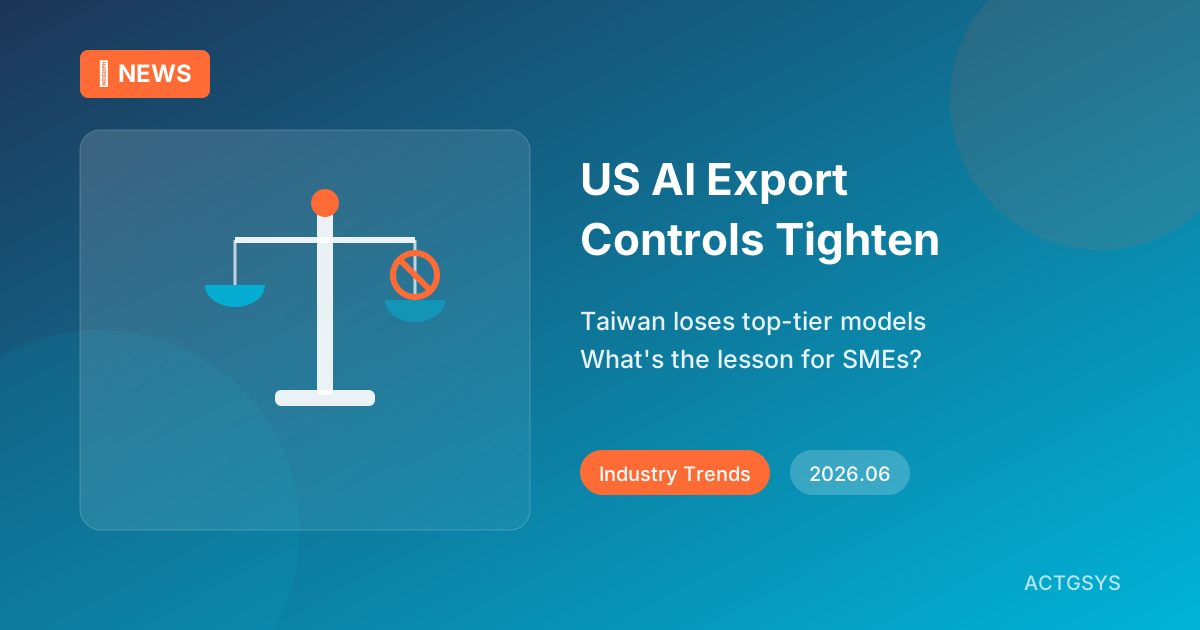
US AI Export Controls Tighten and Anthropic Briefly Pulls Fable 5 (2026): Taiwan SMEs Suddenly Lose Top-Tier Models
In June 2026 the US escalated AI model export controls: a June 2 executive order, 'Promoting Advanced Artificial Intelligence Innovation and Security,' was followed mid-month by an order requiring Anthropic to block Mythos 5 and Fable 5 for non-US nationals — briefly disabling both for all customers. Taiwan SMEs are 'non-US nationals' and were directly affected. Here's the event, the risk, and a multi-model fallback strategy.
What would this cost you?
Answer five questions. Within three working days you get a price range and what it covers. No deck, no follow-up sales calls.
Prefer to talk?LINE·02-2553-8084