AI Meeting Assistants 2026: Cut 70% of Overhead
AI Meeting Assistants in 2026: The SME Guide to Cutting 70% of Meeting Overhead
Short answer: An AI meeting assistant is an AI agent that automatically generates transcripts, summaries, and action items and syncs them to your work systems — giving each employee back 5–8 hours per week, or two working days per month.
Meetings aren't the problem — what happens after meetings is the productivity sink. According to the Microsoft Work Trend Index (2025), knowledge workers spend an average of 7.8 hours per week processing post-meeting work: writing notes, sending follow-ups, creating to-dos, and chasing who agreed to what. AI meeting assistants in 2026 have evolved from "voice-to-text" into genuine meeting cognition agents — they understand context, extract decisions, and sync to CRM and ERP. This guide breaks down the capabilities and a realistic SME deployment path.
What Is an AI Meeting Assistant?
An AI meeting assistant is an AI agent combining speech recognition, large language models, and workflow automation to produce real-time and post-meeting artifacts: transcripts, summaries, action items, and system sync. According to Gartner (2026), 60% of enterprises will deploy AI meeting assistants in 2026 — a 3× jump from 18% in 2024.
The fundamental shift from traditional recording tools: recording leaves an audio file; AI meeting assistants produce structured knowledge — searchable, linkable, trackable.
Traditional Meeting Flow vs. AI Meeting Assistant Flow
| Stage | Traditional | AI Meeting Assistant |
|---|---|---|
| During meeting | Someone types, attention split | Live transcript generated automatically |
| 30 min after | Clean up notes, reconstruct points | Structured summary already produced |
| 2 hours after | Write follow-up emails | Action items already assigned |
| 1 day after | Manual CRM / task entry | Already synced |
| 1 week after | Can't find what was decided | Full-text search any keyword |
Four Core Capabilities of 2026-Grade AI Meeting Assistants
Mainstream tools in 2026 fall along four capability tiers. The more mature the tool, the closer it lives to Tier 4.
Capability 1: High-Accuracy, Multilingual Transcription
Real-time transcripts are table stakes, but "usable" transcripts require three things:
- Speaker diarization — distinguishing who said what
- Code-switching support — Taiwan meetings often mix Chinese and English ("這個 pipeline 要 follow up 一下"); the model must natively handle it
- Proper noun learning — company names, product names, and people must be learned from historical meetings and improve over time
Accuracy benchmark: 92%+ for clean traditional Chinese, 85%+ for code-switched, 88%+ for technical domains.
Capability 2: Structured Summarization
Nobody reads raw transcripts. Useful summaries apply different structures by meeting type:
- Sales calls: customer pain points, budget signals, next steps
- Project meetings: progress, risks, blockers, decisions
- 1:1s: performance highlights, challenges, development needs
- Board meetings: financials, strategic decisions, votes
A mature AI meeting assistant auto-detects meeting type and applies the right template.
Capability 3: Action Item Extraction and Assignment
This is the highest-ROI feature. The AI extracts from the transcript:
- Commitments: "I'll send it by Monday" → action item
- Decisions: "We're going with option B" → decision log
- Open questions: "We need to verify this technically" → follow-up
Each action item is auto-annotated with owner, due date, and surrounding context.
Capability 4: Deep Enterprise Integration
Advanced AI meeting assistants aren't islands — they plug into your work systems:
- CRM: sales meeting outcomes auto-update stages and opportunities in DanLee CRM
- Task management: action items flow to Asana, Notion, ClickUp
- ERP: supplier meeting decisions sync to Dinkoko ERP
- Knowledge base: historical meetings become a searchable private corpus
Integration depth is the most-overlooked, highest-impact selection criterion for SMEs.
Why SMEs Benefit More Than Enterprises
Large companies have executive assistants to take notes. SMEs typically don't. According to the Taiwan SME Administration (2025), 85% of Taiwan SMEs rely on managers or sales leads to take their own meeting notes, burning 6.3 hours per week — time that should go into customer development or strategy.
Three SME-specific leverage points:
1. Founders attend too many meetings. SME founders span product, sales, and finance meetings. Memory load is extreme. AI meeting assistants turn each meeting into a searchable decision journal.
2. Sales information leaks heavily. A sales rep finishes a customer meeting — key context stays in their head. AI meeting assistants push customer pain points and competitive intel straight into the CRM, reducing knowledge loss when people leave.
3. Cross-functional handoffs break. Sales commits to something, engineering doesn't hear about it; engineering changes the spec, support isn't told. AI meeting assistants create one shared decision surface and kill the "who-said-what" arguments.
A 4-Week SME Deployment Path
ACTGSYS has deployed AI meeting assistants at 20+ SMEs over the last 12 months. Typical timeline is 4–6 weeks:
Week 1: Audit and selection
- Inventory meeting types and volume (sales, project, internal, customer)
- Confirm language requirements (pure Chinese, code-switched, multilingual)
- Evaluate 3–5 tools with integration depth as the primary criterion
Week 2: Security and compliance setup
- Confirm data residency (domestic vs. overseas)
- Define exemption rules for sensitive meetings (legal, HR)
- Roll out disclosure language and consent forms for customer calls
Week 3: Integration and template configuration
- Connect DanLee CRM, task systems, knowledge base
- Build summary templates per meeting type
- Upload company-specific vocabulary and people directories
Week 4: Pilot and training
- Run with 2–3 teams for one week
- Gather user feedback and tune
- Roll out company-wide with clear usage KPIs
Six Selection Criteria for SMEs
The market has 50+ AI meeting assistants. SMEs should evaluate along these six dimensions:
| Criterion | Why It Matters | Question to Ask Vendor |
|---|---|---|
| Chinese accuracy | Directly drives usability | Provide a 30-min traditional-Chinese trial |
| Data residency | Compliance and security | Taiwan or Asia data center option? |
| CRM / task integration | Determines actual time savings | Which systems have two-way sync? |
| Speaker diarization | Drives summary quality | Supports live diarization without pre-training? |
| Custom summary templates | Matches industry needs | Switchable by meeting type? |
| Pricing model | Economics at scale | Per-user, per-minute, or flat monthly? |
Three Hidden Traps SMEs Fall Into
Miss these and pain follows:
Trap 1: Optimizing for transcript accuracy instead of summary quality. A 95%-accurate transcript paired with a messy summary saves no time. Evaluate "summary quality" directly, not raw transcripts.
Trap 2: Skipping customer disclosure. Recording customer meetings without explicit disclosure and consent can violate local privacy law and EU GDPR (if any customer is in Europe). ACTGSYS deployments include compliance templates and customer consent forms.
Trap 3: Ignoring data residency risk. Many international tools store transcripts in US data centers. For sensitive commercial content (trade secrets, M&A, financials), that risk can be severe. SMEs should prioritize vendors that support local deployment or Asia data centers.
Expected KPIs After 90 Days
Average outcomes across ACTGSYS customers:
| Metric | Before | After 90 days | Change |
|---|---|---|---|
| Post-meeting cleanup time | 45 min/meeting | 3 min/meeting | -93% |
| Decisions lost between meetings | 32% | 6% | -81% |
| Action item completion rate | 54% | 87% | +61% |
| Weekly total meeting time | 22 hrs | 15 hrs | -32% |
| Customer info in CRM completeness | 43% | 91% | +112% |
Meeting time drops not because teams cut meetings, but because prep improves and no one is splitting attention taking notes — so each meeting naturally runs tighter.
Frequently Asked Questions
Can AI meeting assistants handle in-person meetings?
Yes. Mainstream tools support three modes: (1) online meeting recording (Zoom, Google Meet, Teams); (2) in-person recording via dedicated microphone devices; (3) direct mobile app recording. ACTGSYS recommends the right mode based on your actual meeting mix.
What about privacy and data security risks?
Real but manageable. Three essentials: (1) choose a vendor supporting local deployment or Taiwan data centers; (2) define exemption rules for sensitive meetings; (3) get signed consent from customers. ACTGSYS provides a complete compliance framework and templates.
Can AI meeting assistants fully replace human note-takers?
For most day-to-day meetings, yes. For board meetings, legal proceedings, and major contract negotiations, keep a human for dual assurance — use AI output as the first draft and a human for final review.
How much does it cost for an SME?
Two typical tiers: (1) SaaS subscriptions at US$12–40 per user per month; (2) enterprise integrations (CRM sync, custom templates, data security) starting at US$2,600–5,000 setup plus US$500–1,000 monthly. A 20-person SME typically runs US$10,000–17,000 annually, with payback in 3–4 months.
Will employees resist being "recorded"?
Some will. Counter with: (1) explicit messaging that recording exists to save their time, not to monitor; (2) let them opt out for personal sensitive meetings; (3) share time-savings data from the pilot team. Most adopters stop wanting to work without it after two weeks.
Closing: The Most Underrated Productivity Lever for SMEs
Compared with flashy AI applications like SDRs or AI customer service, AI meeting assistants look unremarkable — but they deliver the most consistent ROI with the lowest resistance, benefiting every team. Many ACTGSYS customers start their AI journey here, then expand into larger transformation programs.
Ready to give your team back two working days a month? Contact ACTGSYS for a free AI meeting assistant readiness assessment, backed by our 90-day ROI guarantee. Learn how we integrate AI meeting assistants with DanLee CRM.
Last updated: 2026-04-15
Products & Solutions in This Article
AI-powered CRM for lead management, customer tracking, and sales pipeline optimization designed for SMEs.
Intuitive accounting system designed for Taiwan SMEs, with automated bookkeeping and financial reporting.
Related Articles
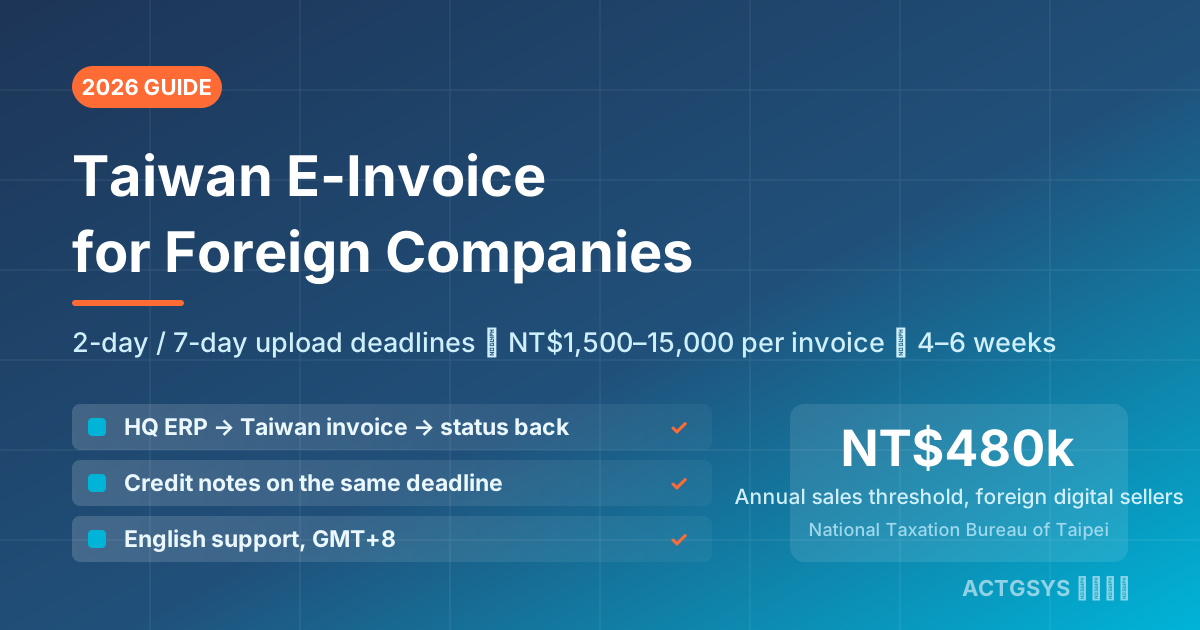
Taiwan E-Invoice for Foreign Companies 2026 - Cost
How a foreign-owned Taiwan subsidiary or branch connects its ERP to Taiwan's e-invoice platform: 2-day B2C / 7-day B2B upload deadlines, NT$1,500–15,000 per-invoice penalties, three integration paths, and a 4–6 week project from NT$50,000.
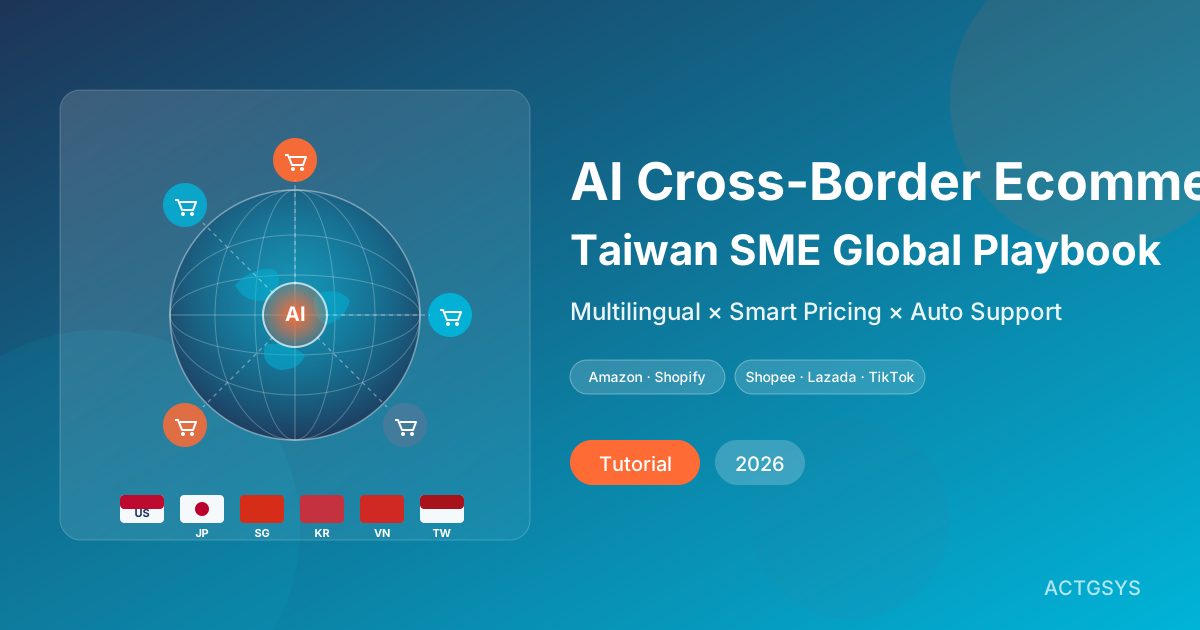
AI Cross-Border Ecommerce Playbook for SMEs (2026)
How Taiwan SMEs use AI to automate cross-border e-commerce — multilingual listings, smart customer service, dynamic pricing, ad ops, and logistics forecasting across Amazon, Shopify, Shopee, Lazada, and TikTok Shop.
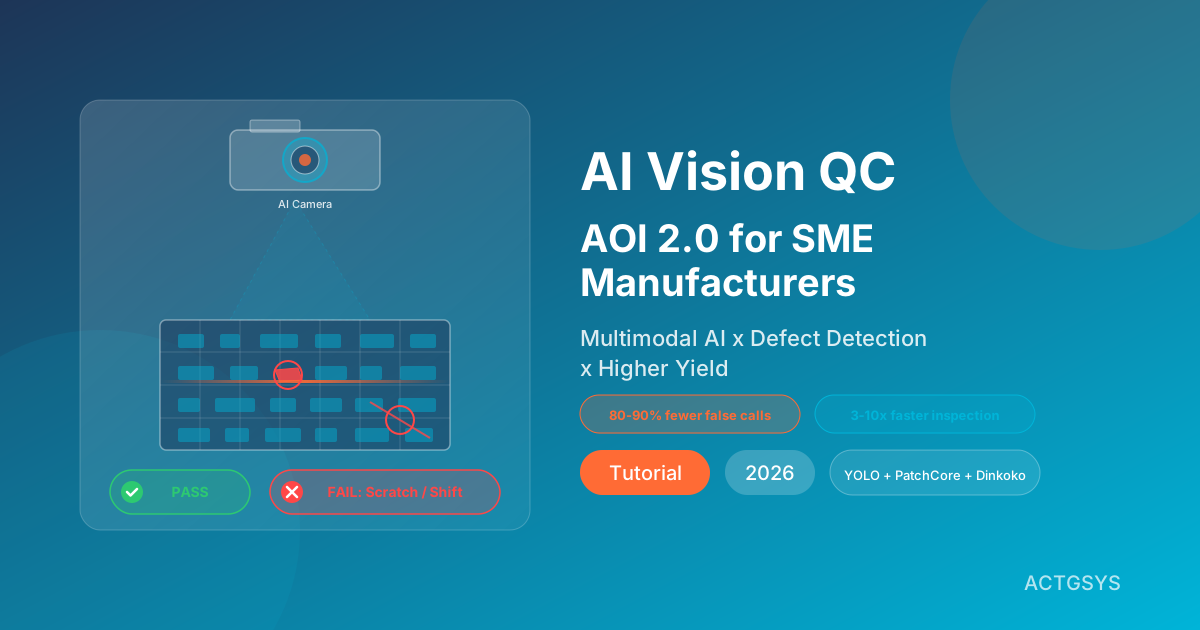
AI Vision Quality Control 2026: AOI 2.0 for SMEs
A deep dive into how AI vision QC (AOI 2.0) combines computer vision with multimodal LLMs to automate defect detection, raise yield and shrink inspection time. Includes a five-step rollout, platform comparison and FAQ.
What would this cost you?
Answer five questions. Within three working days you get a price range and what it covers. No deck, no follow-up sales calls.
Prefer to talk?LINE·02-2553-8084